Sustainability
We have an important role to play in creating a more sustainable and inclusive future.

We have an important role to play in creating a more sustainable and inclusive future.

Our report provides an update on how we are Helping Britain Prosper in a way that delivers long-term profit and returns.

We put you first, so you can put our customers first.
Our report provides an update on how we are Helping Britain Prosper in a way that delivers long-term profit and returns.

Disclosures relating to our strategic, financial, operational, environmental and social performance.

See all the key dates in the financial year.

Higher, more sustainable returns as we continue to Help Britain Prosper.

We've ranked in the top 10 employers for both graduates and apprenticeships in The Times Top 100.

We're searching for the best talent to join us in Leeds.

Join us as we explore new ideas and technologies to reshape the world of finance.
We have an important role to play in creating a more sustainable and inclusive future.
Our report provides an update on how we are Helping Britain Prosper in a way that delivers long-term profit and returns.
We put you first, so you can put our customers first.
Our report provides an update on how we are Helping Britain Prosper in a way that delivers long-term profit and returns.
Disclosures relating to our strategic, financial, operational, environmental and social performance.
See all the key dates in the financial year.
Higher, more sustainable returns as we continue to Help Britain Prosper.
We've ranked in the top 10 employers for both graduates and apprenticeships in The Times Top 100.
We're searching for the best talent to join us in Leeds.
Join us as we explore new ideas and technologies to reshape the world of finance.
A spotlight on financial empowerment across life stages and ages

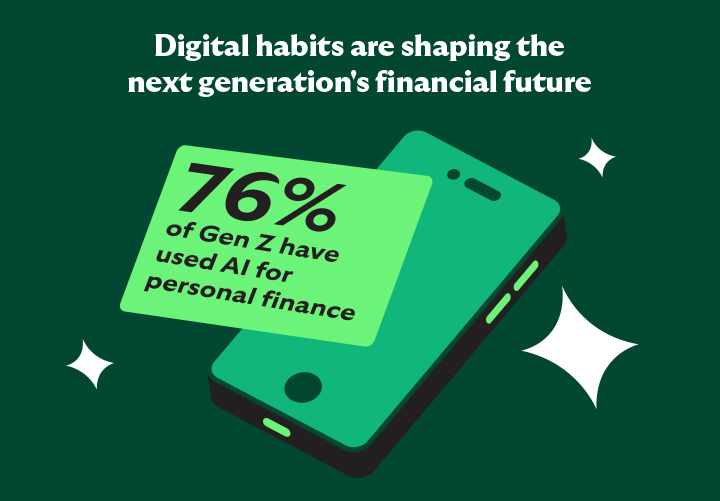
Digital finance is a powerful tool for supporting prosperity, but not everyone is equally able to turn access into meaningful financial progress.
This Spotlight report explores how financial empowerment – having the confidence, capability and control to make informed financial decisions – varies across different life stages and age groups in the UK. Drawing on insights1 from Lloyds Banking Group’s Consumer Digital Index² this report examines how people use digital tools³, including AI, and how that use appears to be associated with financial behaviours, confidence and outcomes.
The findings focus on digitally engaged adults and should be considered alongside the wider Consumer Digital Index, which explores digital access, capability and inclusion across the UK. This Spotlight does not assess digital access or inclusion directly.

For more than a decade Lloyds Banking Group’s Consumer Digital Index has helped us understand how people are using digital tools in everyday life. More recently, our Lives empowered, a nation empowered report looked at what financial empowerment really means – and why confidence, support and access to the right tools matter and can enable better financial outcomes.
This Spotlight brings those ideas together. It looks at how people experience financial empowerment at different stages of life, and how digital tools can help them feel more confident, more informed and more in control of their money as their needs, responsibilities and priorities change over time.
What comes through clearly is that financial empowerment does not look the same for everyone. Someone starting out in adult life may need help building confidence and healthy money habits. Someone supporting a family, managing a mortgage or dealing with competing pressures may need tools that help them stay on top of things. Later in life, it may be about maintaining independence, security and trusted support.
Financial empowerment looks different at every stage of life, and so does the role digital tools and AI play in supporting it. The analysis reveals:
The findings in this report point to four broad, overlapping pathways that help explain how financial empowerment appears to evolve across the course of people’s lives.
These pathways are intended to provide context rather than categorise people. They are illustrative and directional, not fixed labels. Individuals may move between them, or experience aspects of several at once, depending on their circumstances, confidence, financial priorities and support needs.
Read alongside the generational findings, the pathways help illustrate how the role of digital tools can shift over time – from exploration and action to progress, confidence and control. The pathways are defined as follows:

Building understanding and confidence
At this stage, digital tools can support access, discovery and learning. Exposure to digital finance, social platforms and AI may be high, but financial behaviours, confidence and trust are still developing.

Turning engagement into everyday habits
Digital tools are used more actively for day-to-day money management, including budgeting, saving, credit-building and planning. The opportunity is to help people turn engagement into consistent financial behaviours.

Using tools to support bigger financial goals
Financial decisions become more complex, and digital tools become more embedded in planning, borrowing, saving, debt reduction and goal-setting. The opportunity is to support informed decisions and sustained financial momentum.

Maintaining security, trust and independence
Digital tools support oversight, stability and confidence, but use may become more selective. Trust, security, accessibility and human support become increasingly important, particularly for more complex or sensitive decisions.
The findings below explore how financial empowerment is experienced across different generations and age groups, highlighting the distinctive opportunities and challenges that emerge at different stages of life.
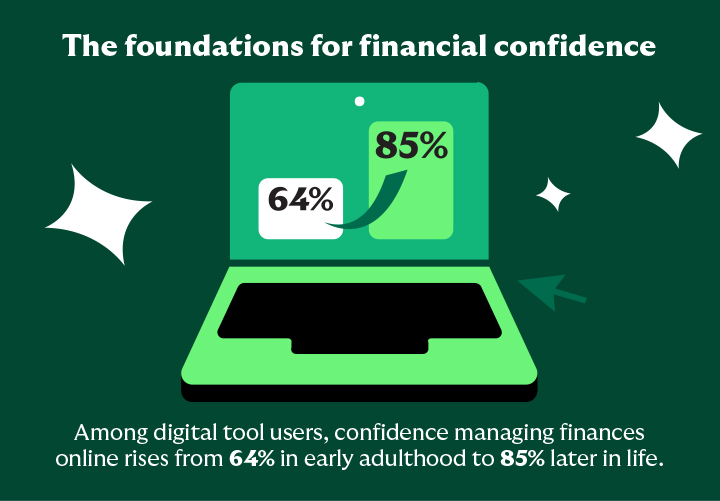
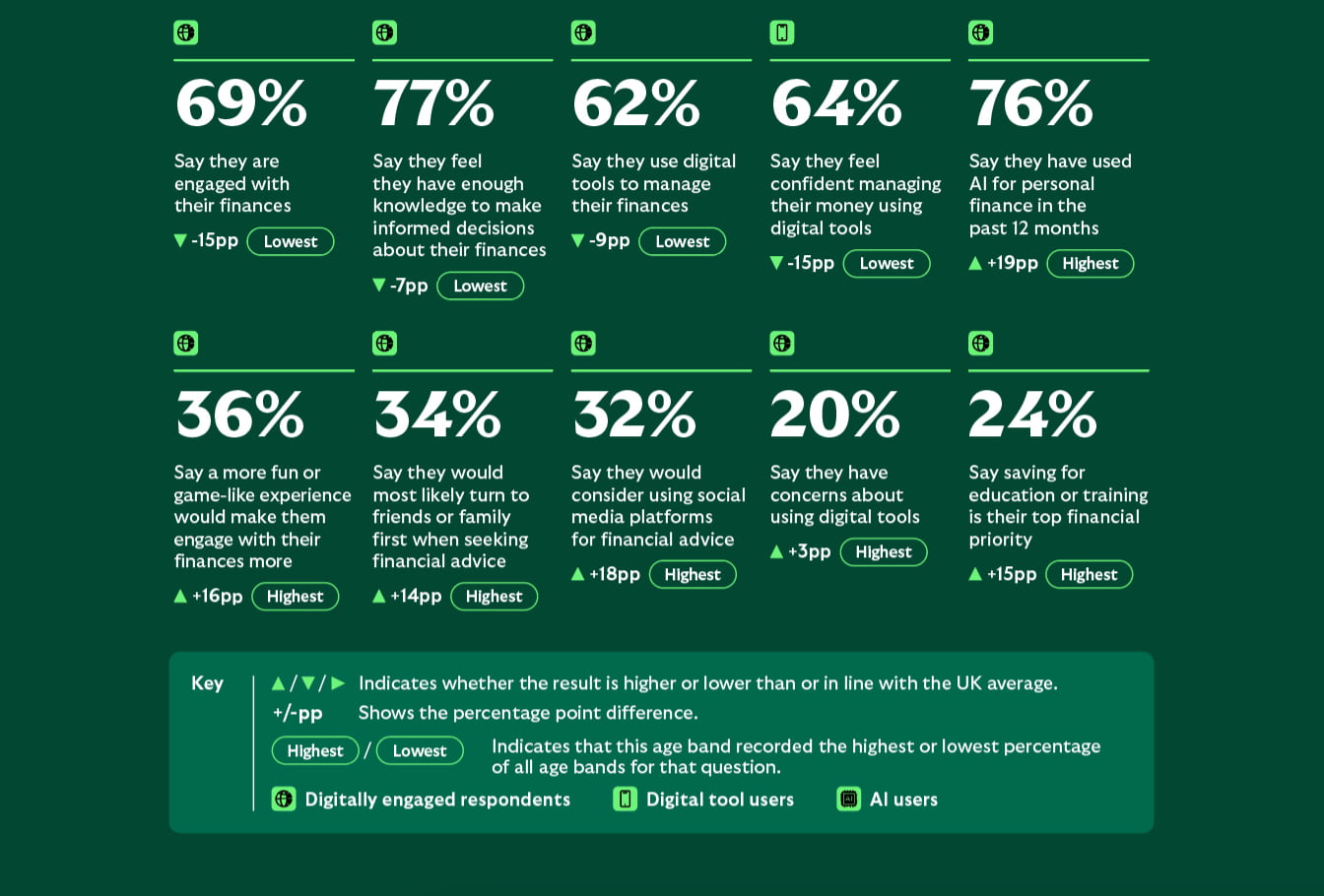
Financial empowerment among 18-24s is still emerging. This group shows a high level of exposure to digital finance, social platforms and AI, but this does not yet translate into the same levels of financial engagement, knowledge or confidence seen among other generations.
Digital tools and AI play a visible role in the ways that younger adults explore financial information and manage money. However, financial habits and behaviours are still developing alongside key life-stage transitions, including education, work and growing independence.
In terms of pathways, this group reflects exploration. At this stage, exposure to digital finance is high, and digital tools support access, discovery and learning. However, engagement, confidence and financial outcomes are still developing.

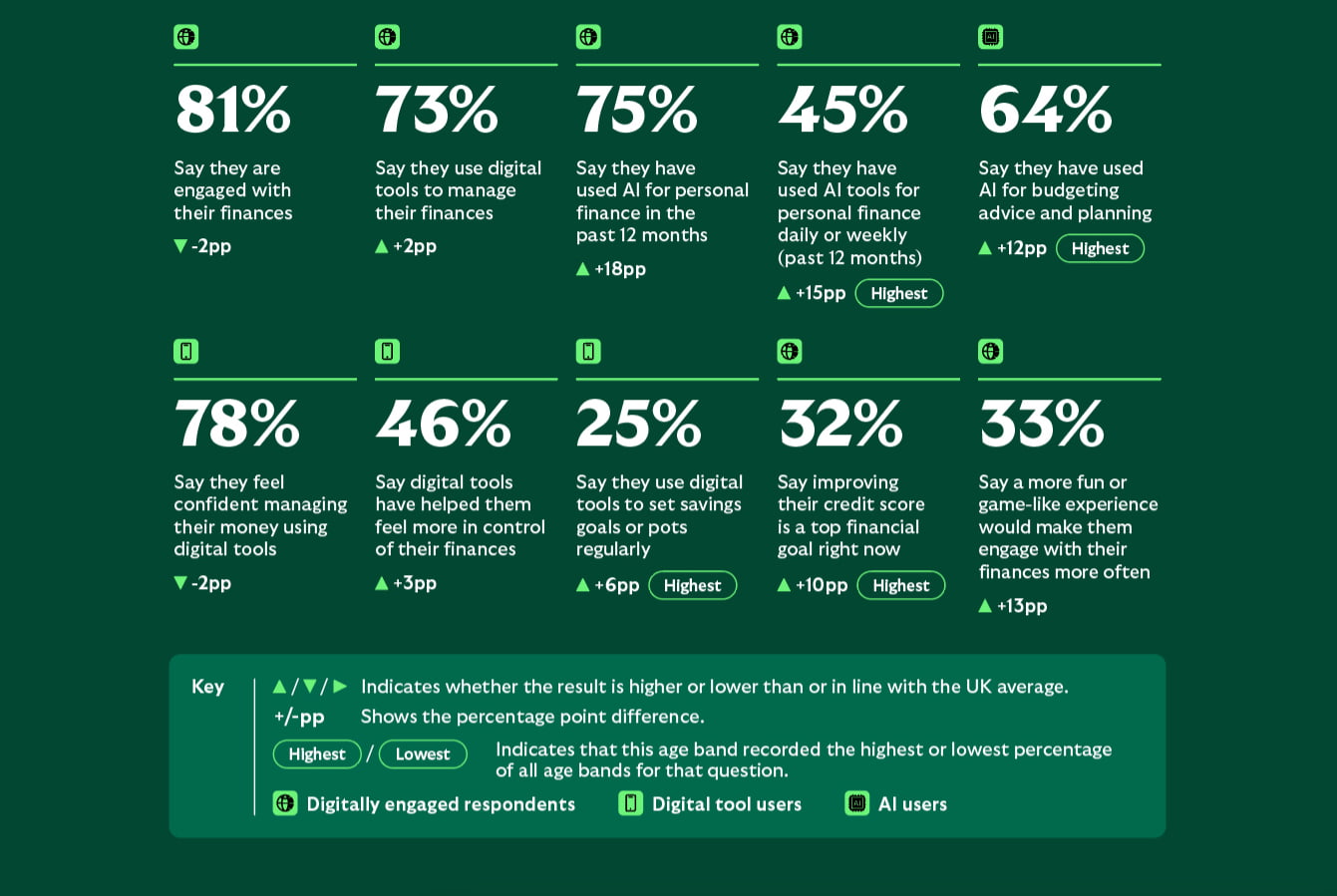
Financial empowerment among older Gen Z and younger Millennials is characterised by growing financial responsibility and more purposeful money management. Digital tools and AI are increasingly becoming part of how this group budgets, builds credit, saves and plans ahead.
Compared with younger adults, the pattern shifts from exploration to more consistent action. However, as financial decisions become more complex, confidence does not always keep pace with usage.
In terms of pathways, this group reflects action. At this stage, digital tools are more actively used to support day-to-day money management, including budgeting, saving and credit-building. Engagement is high, and digital tools are increasingly supporting practical financial behaviours, although confidence and understanding continue to develop alongside more complex financial decisions.

Financial empowerment among older Millennials shows a close association between digital engagement and practical financial outcomes. This group is using digital tools and AI to support behaviours such as saving, debt reduction, goal-setting, borrowing decisions and planning.
The pattern appears to reflect a move from purposeful use to more visible self-reported financial behaviours and outcomes. However, as financial decisions become more complex, trust and confidence remain important, particularly around AI-enabled support.
In terms of pathways, this group reflects progress. At this stage, digital tools and information are more embedded in financial decision-making, supporting planning, goal-setting and more complex financial choices. Engagement appears increasingly associated with real-world behaviours, though outcomes remain shaped by wider factors such as financial pressure, confidence and competing priorities.

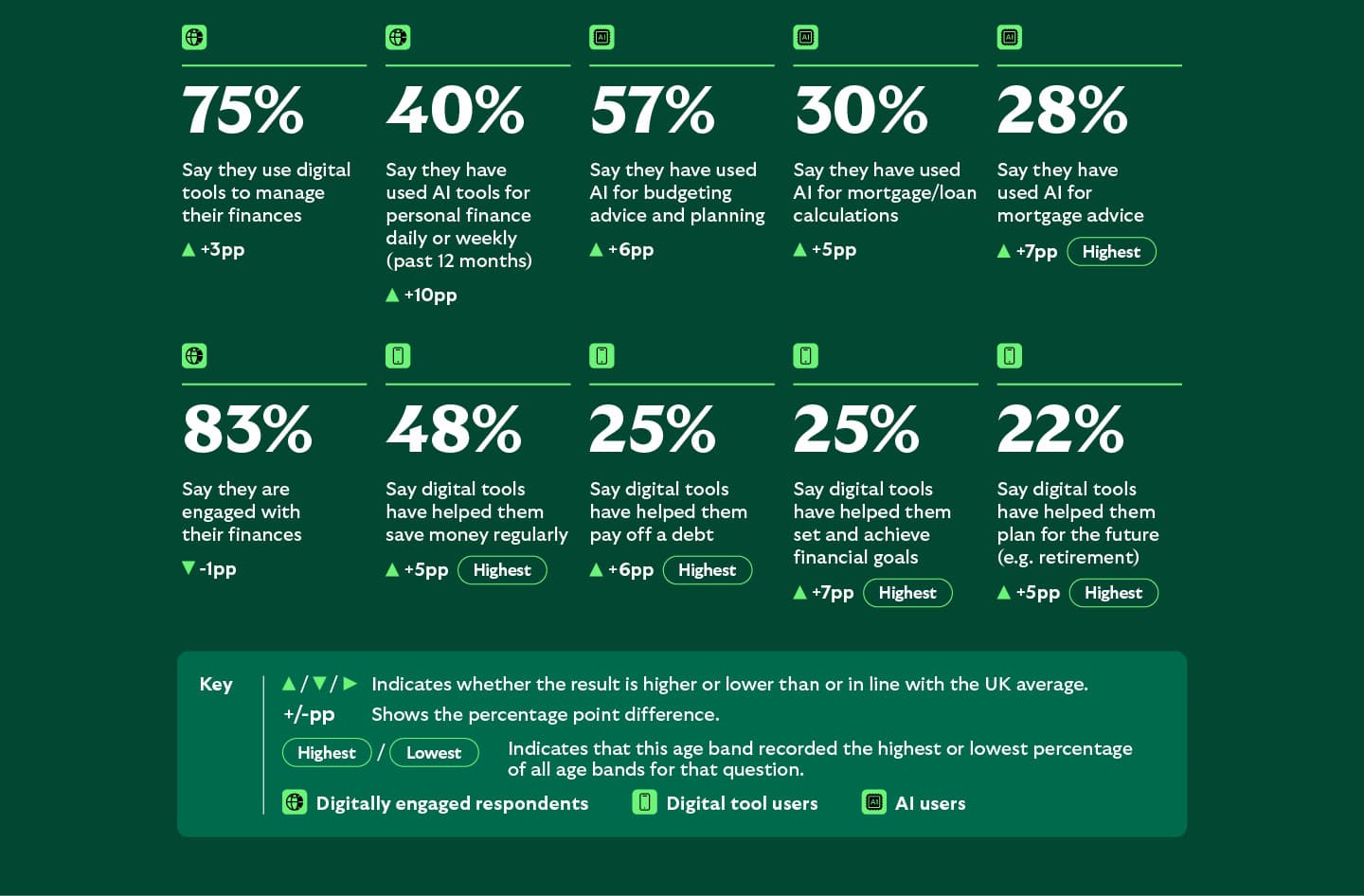
Financial empowerment among those in the younger Gen X group is shaped by a high level of financial engagement, regular use of digital tools and a wider set of responsibilities. Use of digital tools is among the highest across the age groups.
Many are managing day-to-day finances while also balancing debt, supporting a family, and longer-term planning. Digital tools appear to support oversight and control, although the extent to which this translates into longer-term financial outcomes varies. AI use is present for practical tasks, while concerns around scams, misinformation and trust influence how these tools are used.
In terms of pathways, this group reflects progress. At this stage, digital tools support increasingly complex financial responsibilities, helping people balance debt, family commitments and longer-term financial goals. Digital engagement extends beyond day-to-day management towards supporting informed decisions, resilience and sustained financial momentum.

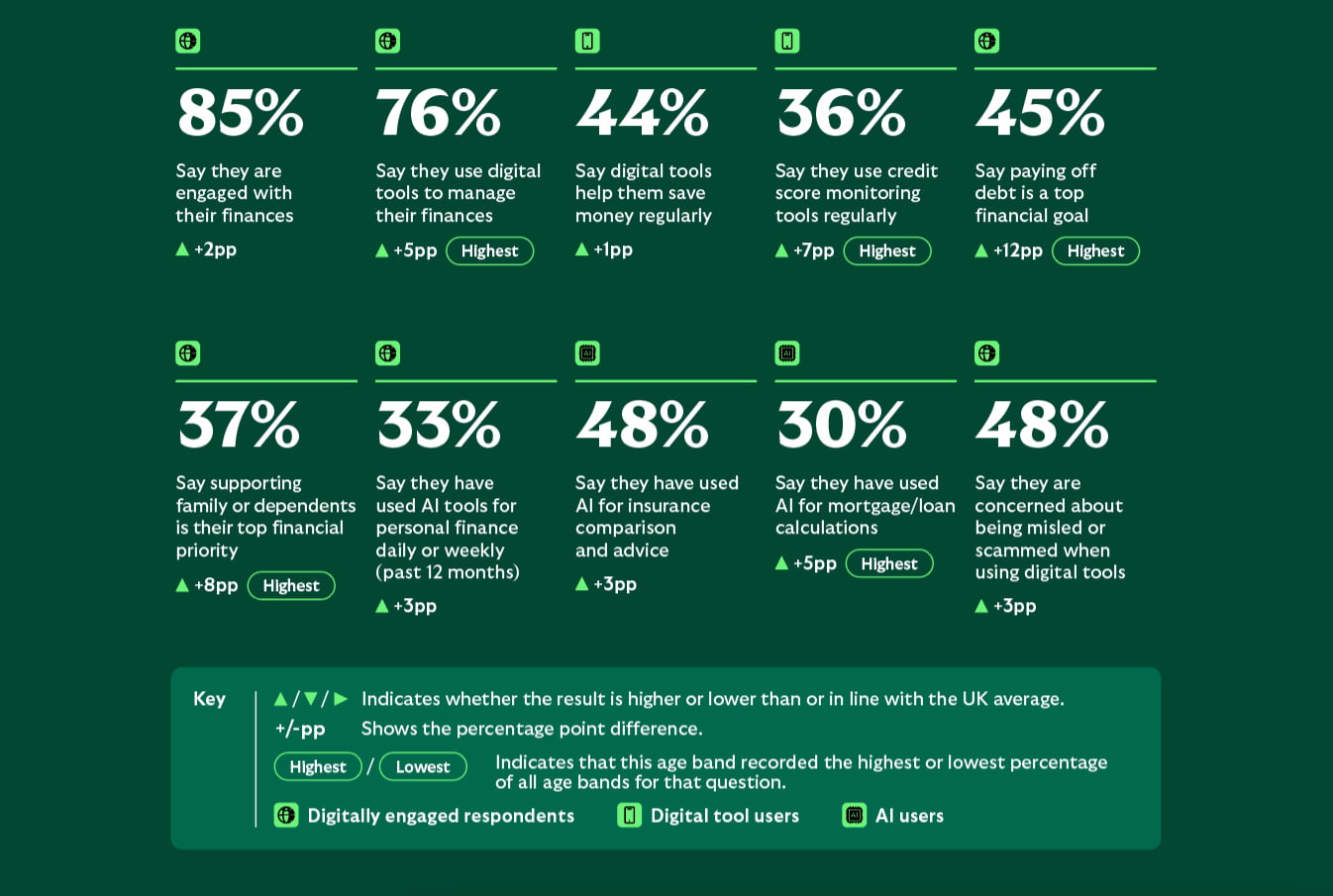
Financial empowerment among older Gen Xers is shaped by the need to maintain day-to-day control while preparing for retirement. Digital tools are widely used and confidence among users appears to be at a relatively high level.
There is evidence that these tools support control and, for some, longer-term planning, including pensions, investments and savings. However, AI use appears more selective, and concerns around security and privacy remain important.
In terms of pathways, this group reflects confidence and control. At this stage, digital tools support both ongoing financial management and forward planning, particularly in preparation for later life. Engagement remains strong, but usage becomes more selective, with trust, confidence and perceived risk shaping how people engage with newer tools and services.

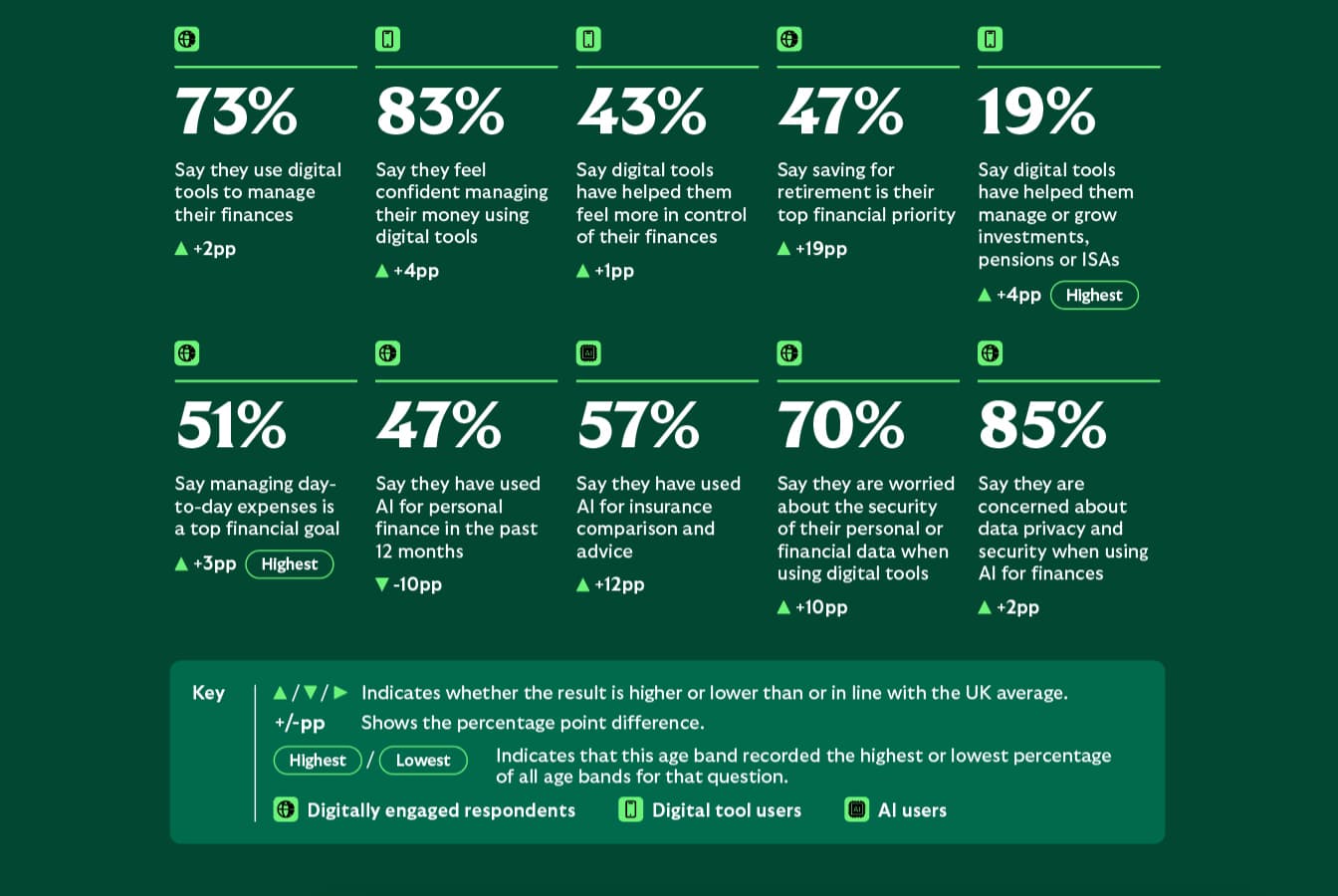
Financial empowerment among younger Baby Boomers is characterised by high financial engagement and strong confidence among those using digital tools. While use of digital tools is slightly lower than in younger groups, many report that these tools support a strong sense of control.
Financial priorities reflect a balance between maintaining day-to-day financial stability and continuing to plan for longer-term needs, including retirement. Digital tools can support control, but use of AI is lower and more selective. Trust, security and preference for established sources of advice, such as banks or building societies, play a significant role in how this group engages with newer technologies.
In terms of pathways, this group reflects confidence and control. At this stage, digital tools are used to support ongoing financial management and maintain a strong sense of oversight. Engagement remains high, but use becomes more selective, with trust in established sources and concerns around data privacy shaping how and when people choose to use digital and AI-enabled support.

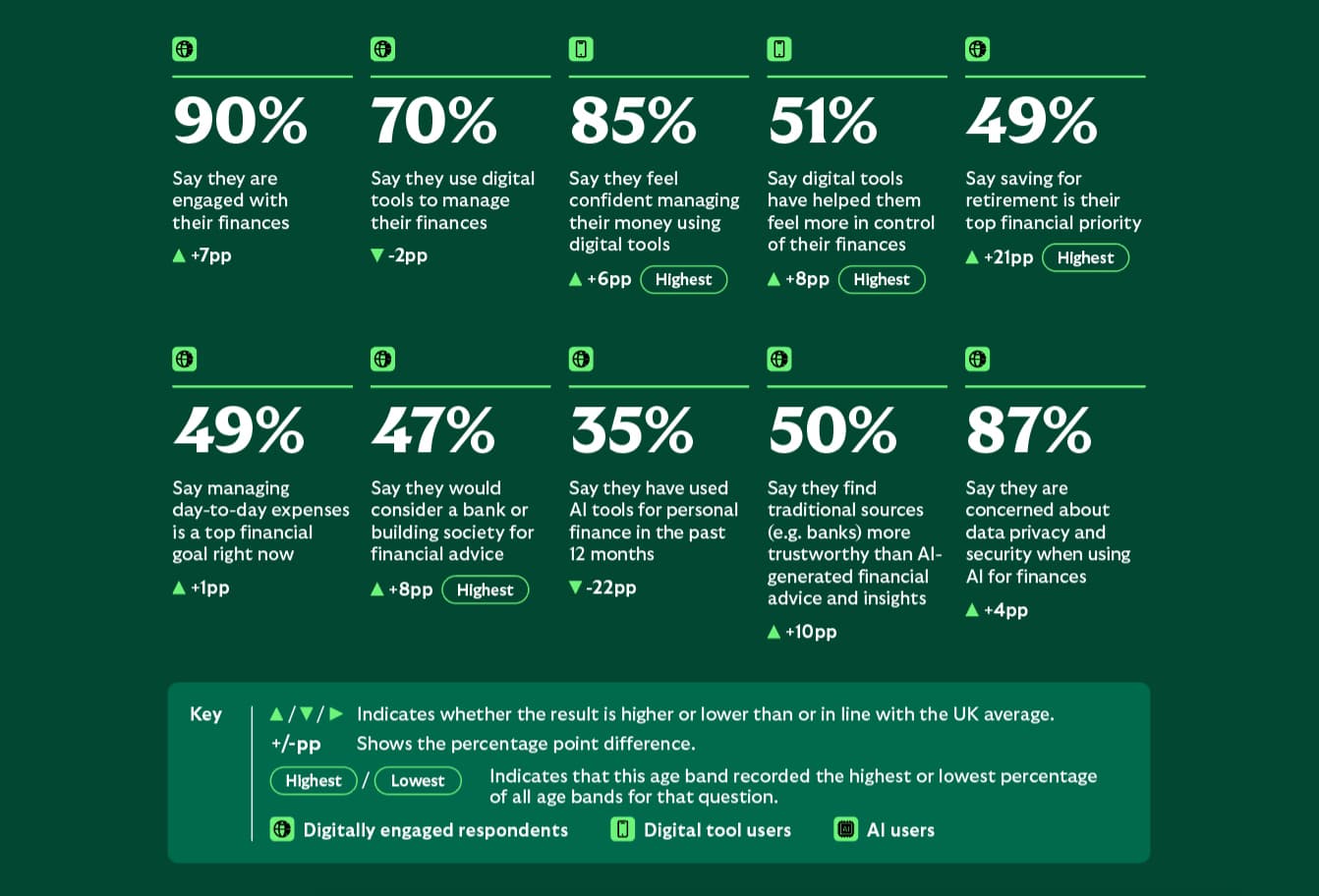
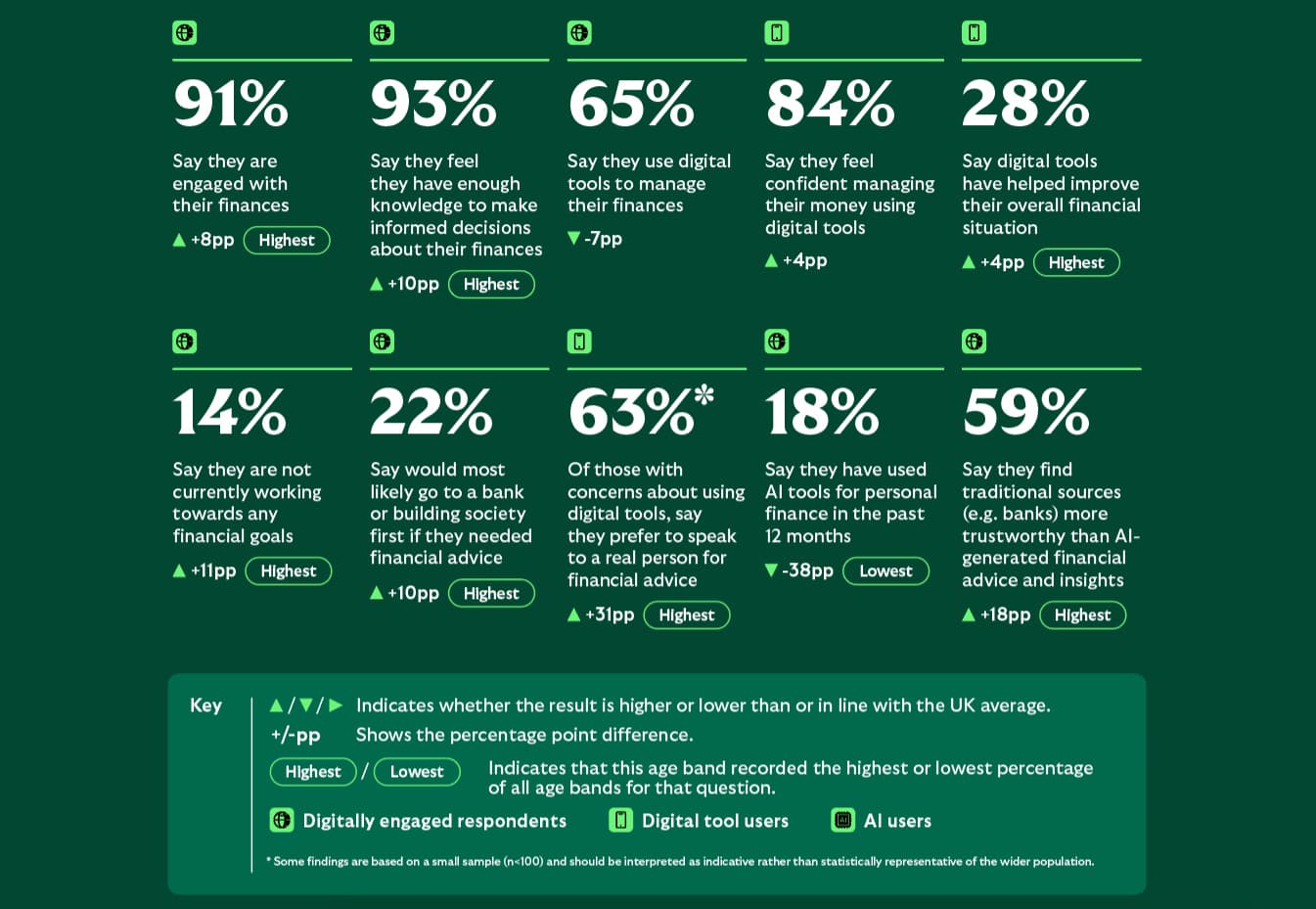
Financial empowerment among people aged 75+ is characterised by very high levels of financial engagement, confidence and self-reported knowledge. Financial behaviour appears less focused on actively working towards new financial goals, suggesting a greater emphasis on maintaining financial stability, confidence, and control.
Use of digital tools is lower than in younger age groups, although a majority still report using them to manage their finances. Those who do use digital tools report high levels of confidence and are more likely than any other age group to say these tools have improved their overall financial situation.
Use of AI is comparatively low, while trust and human support appear to play a more prominent role in shaping behaviour. Many express a preference for established sources of advice, such as banks and building societies, and place greater value on speaking to a real person when making financial decisions.
In terms of pathways, this group reflects confidence and control. At this stage, financial decision-making is shaped by strong levels of experience and confidence, with digital tools used alongside trusted providers and human support. Engagement remains high, but use of digital and AI-enabled tools is more selective, reflecting a preference for reassurance, trust and ease of use.

"Milestones matter. Having access to the right support, guidance and tools at the right moment can help people feel confident and prepared when key financial decisions arise."
The findings suggest that financial empowerment cannot be approached as a single challenge with a single solution. People's priorities, pressures and support needs change throughout life, meaning that the tools, guidance and interventions most likely to improve outcomes will often differ across life stages.
The opportunity is not simply to increase digital engagement, but to ensure that products, services, guidance and support reflect people's changing needs. By enabling individuals to access the right combination of digital tools and human support at the right time, it is possible to build confidence, support informed decision-making and strengthen financial outcomes throughout life.
The following priorities identify where targeted action could have the greatest impact:
"This is the opportunity for the future. Not simply to increase digital engagement, but to help people use digital tools, including AI, alongside support and guidance in ways that work for them at every stage of life."
The Spotlight reports signal the future direction of the Consumer Digital Index: moving beyond digital engagement alone to better understand how digital tools, AI, guidance and human support can help people build financial confidence and improve outcomes in practice.
Generation gains shows that financial empowerment changes throughout life. People’s priorities, pressures and support needs evolve from early financial learning, through periods of responsibility and progress, to maintaining confidence, control and independence in later life.
For the Consumer Digital Index, this means continuing to explore not only whether people are digitally engaged, but whether that engagement helps them manage day-to-day finances, build resilience, access appropriate credit, plan ahead and act with confidence.
This is where the opportunity lies: using insight to help ensure digital innovation supports real financial progress, in ways that are trusted, inclusive and relevant to people’s circumstances.
1. Insights in this Spotlight report are drawn from the Consumer Digital Index (published November 2025). The online survey findings (including AI usage and reported savings) are based on self-reported data from a nationally representative (based on age, gender and region) online survey of 5,000 digitally engaged UK adults (fieldwork during the period 3 July to 28 July 2025). Self-reported savings are not verified against transactional data and should be interpreted as perceived impacts, not guarantees of future outcomes.
Correlations shown do not imply causation. References to third-party AI tools or social media platforms are illustrative only; they do not constitute regulated financial advice and are not endorsed by Lloyds Banking Group.
Customers seeking personalised recommendations should use regulated advice channels.
Narrative summaries in this report are interpretive and based on patterns in self-reported data. Statements have been shortened for clarity. Comprehensive data tables with full survey questions, context and survey base sizes can be downloaded via our website here: Consumer Digital Index - Lloyds Banking Group plc.

2. The Consumer Digital Index (CDI) published in November 2025 combines anonymised behavioural data and nationally representative survey data to track digital engagement and financial capability across the UK. Earlier editions included a composite index score reflecting access, capability and use. Full methodology, data tables and report archives are available on the CDI website: Consumer Digital Index - Lloyds Banking Group plc.
3. Digital tools refers to online and mobile financial services used to manage money, including websites, banking apps, spending insights, alerts, notifications and credit score monitoring tools.
Digital tool usage refers to respondents who say they use the internet or digital tools to manage their finances.
References in this report reflect self-reported usage among digitally engaged individuals and cover a range of activities, from checking balances and tracking spending to saving, planning and using AI-enabled services.
4. This analysis is based on age bands from an online survey of 5,000 digitally engaged UK adults. These age bands broadly align with commonly used generational groupings, including Gen Z, Millennial, Gen X and Baby Boomers; precise mapping is not imposed.
Definitions may vary, and some age bands may sit between or across generations. In this report generational references are used as a contextual guide alongside age-based analysis, rather than as a strict analytical framework.
The analysis focuses on how financial behaviours and outcomes are shaped by life stage, context and individual circumstances. It does not seek to rank generations or age groups, or imply superiority of any given group in any way. Instead, it reflects a lifecycle approach, exploring how financial empowerment takes different forms across life stages, shaped by evolving priorities, experience and patterns of digital engagement.
5. The pathways described in this report were developed through analysis of survey responses relating to financial engagement, confidence, digital tool usage, financial behaviours, financial goals, trust and self-reported outcomes across different age groups. They do not represent fixed categories or labels applied to specific groups or individuals. Instead, they represent overlapping patterns of financial behaviour and outcomes, meaning individuals may exhibit characteristics of multiple pathways and move between them over time.
Cross‑cutting factors such as trust, confidence and financial pressure influence how digital tools are used and whether that use translates into meaningful financial action and improved outcomes. Where generations and age groups are described as reflecting a pathway, this should be understood as directional and illustrative rather than definitive.

Through simple digital tools, personalised insights and timely guidance, we're helping people make informed decisions every day and take small but meaningful steps toward stronger financial futures.

8 May 2026 | Jas Singh
When people are financially empowered, they are better able to make informed financial decisions. They can spot opportunities, avoid costly mistakes, and make choices that align with their priorities and circumstances.

Money mapped explores how people across the UK use digital tools to manage money and achieve different financial goals, giving a clear view of financial empowerment across the UK’s nations and regions.
Financial empowerment means having the confidence, capability and control to make informed financial decisions. It is about being able to manage money effectively, build resilience, plan ahead, act with confidence and make decisions that support long-term financial wellbeing. Digital tools, including AI, alongside trusted guidance and human support, can all play a role in helping people achieve this. Read our article on financial empowerment to find out more.
Geniration gains is a Lloyds Banking Group spotlight on financial empowerment across age groups and life stages. It explores how digitally engaged UK adults use digital tools and AI for personal finance, and how confidence, trust, behaviours and support needs change through life. It uses data from the 2025 Consumer Digital Index by Lloyds Banking Group, the UK’s largest study of digital and financial capability.
Financial empowerment is not one-size-fits-all. For younger adults, it may mean understanding money, building habits and gaining confidence. In mid-life, it can mean managing debt, family responsibilities, borrowing and long-term goals. Later in life, it often means maintaining security, independence, trust and control.
The main finding is that digital tools, including AI, can be a powerful enabler of financial empowerment, but the ways people use them, and the benefits they report, vary throughout life. Younger adults are leading the adoption of AI for personal finance, while older adults often report stronger financial confidence and a greater sense of control.
Together, the findings suggest that improving financial empowerment is not about a single tool or solution. Instead, people may benefit from different combinations of digital tools, trusted guidance and human support, delivered through the channels they use and trust most at different stages of life.
No. The report shows that digital access, AI use and online confidence do not automatically create financial empowerment alone. Financial confidence is shaped by experience, trust, knowledge, practical support and the ability to turn digital engagement into informed financial action. Different tools, guidance and support can help people achieve financial empowerment depending on their circumstances and goals.
Digital confidence can make it easier for people to manage money, compare options, access support and take action. The Consumer Digital Index finds that people who feel confident online are more likely to say digital tools save them time or money and help them feel more confident managing their finances.
People use AI for personal finance in different ways depending on their life stage. Younger adults are more likely to use AI frequently, especially for budgeting and planning. People in their thirties and forties use AI for more complex financial decisions such as mortgages, loans and debt. Older adults use AI more selectively, often for lower-risk tasks such as insurance comparison.
The report identifies five themes: financial empowerment changes through life; digital tools can support confidence and control when they are trusted and easy to use; AI is becoming part of personal finance but is used differently by age group; trust, privacy and security shape adoption; and people need timely support at key financial moments such as entering adulthood, building credit, buying a home, managing family responsibilities and preparing for retirement.
Younger Gen Z are high users of AI but still building money confidence. Older Gen Z and younger Millennials are using digital tools and AI to budget, save, build credit and plan. Older Millennials are using digital finance to make progress on bigger goals such as saving, debt reduction and home ownership. Gen X are balancing debt, family responsibilities and long-term planning. Baby Boomers and older adults often report high confidence, but use digital tools and AI more selectively, with trust and human support becoming more important.
Older generations are challenging assumptions about digital finance. Many people aged 55 and over use digital tools and some use AI for personal finance, but they tend to be more selective. They place greater value on trusted providers, clear information, data security and access to human support when making financial decisions.
The Consumer Digital Index finds that AI is now being used by millions of UK adults to help manage money. Common uses include budgeting, savings planning, financial education, investment research, debt management and future financial planning.
AI can support financial empowerment when it helps people understand their options, build confidence, make informed decisions and take practical action. The Consumer Digital Index positions AI as a potential tool for empowerment, but only when people can trust the information, understand its limits and access human support when needed.
The main risks are inaccurate, outdated or generic information, a lack of personalisation, privacy and security concerns, and over-reliance on tools that are not regulated financial advice. The Consumer Digital Index stresses that AI tools should be used carefully and that people should have access to trusted guidance and regulated advice where appropriate.
Digital financial literacy means having the skills, confidence and judgement to use digital tools safely and effectively to manage money and make informed financial decisions. It includes understanding how to use online financial services and mobile banking apps, compare financial products, protect personal data, spot scams, interpret digital and AI-generated information and know when to seek trusted guidance or support.
Trust is central to financial empowerment. The Consumer Digital Index shows that people may be willing to use AI and digital tools for money management, but concerns about accuracy, data privacy, security and personalisation affect how far they rely on them. Trusted providers, clear information and access to human support remain important.
The Consumer Digital Index shows that being online and confident with digital tools can help people save time, save money, manage finances and build resilience. But digital inclusion is not only about access. People also need capability, confidence, trust and support to turn digital engagement into stronger financial outcomes.
The findings are based on a nationally representative online survey of 5,000 digitally engaged UK adults. The report focuses on people who are online and examines how digital tools and AI appear to support financial confidence, behaviours and outcomes. It is not a measure of digital access or inclusion. See Context and methodology for more information.
Generation gains identifies four broad financial empowerment pathways: exploration, action, progress, and confidence and control. These pathways are intended to help explain how financial empowerment may evolve throughout life and how people use digital tools, guidance and support at different stages. They are illustrative and directional rather than fixed categories or labels. People may experience aspects of several pathways at once, move between them over time, or follow different journeys depending on their circumstances, priorities, confidence and support needs. The pathways are designed to provide a framework for understanding broad patterns in the data, not to categorise individuals or generations.
Generation gains focuses on digitally engaged UK adults and explores how digital tools and AI may support financial empowerment. It does not assess digital access, digital inclusion or the experiences of people who are not online. Financial empowerment is not dependent on using digital tools. People can build confidence, resilience and control over their finances in different ways, including through trusted guidance, community support, face-to-face services and other non-digital channels. The wider Consumer Digital Index explores digital access, capability and inclusion across the UK.