Sustainability
We have an important role to play in creating a more sustainable and inclusive future.

We have an important role to play in creating a more sustainable and inclusive future.

Our report provides an update on how we are Helping Britain Prosper in a way that delivers long-term profit and returns.

We put you first, so you can put our customers first.
Our report provides an update on how we are Helping Britain Prosper in a way that delivers long-term profit and returns.

Disclosures relating to our strategic, financial, operational, environmental and social performance.

See all the key dates in the financial year.

Higher, more sustainable returns as we continue to Help Britain Prosper.

We've ranked in the top 10 employers for both graduates and apprenticeships in The Times Top 100.
We're searching for the best talent to join us in Leeds.

Join us as we explore new ideas and technologies to reshape the world of finance.
We have an important role to play in creating a more sustainable and inclusive future.
Our report provides an update on how we are Helping Britain Prosper in a way that delivers long-term profit and returns.
We put you first, so you can put our customers first.
Our report provides an update on how we are Helping Britain Prosper in a way that delivers long-term profit and returns.
Disclosures relating to our strategic, financial, operational, environmental and social performance.
See all the key dates in the financial year.
Higher, more sustainable returns as we continue to Help Britain Prosper.
We've ranked in the top 10 employers for both graduates and apprenticeships in The Times Top 100.
We're searching for the best talent to join us in Leeds.
Join us as we explore new ideas and technologies to reshape the world of finance.
Less than a third of our lives outside of work feel like our own, so it’s not surprising that we’re a nation desperate for more free time. The reality is, most of us feel like we just don’t get enough, with the amount of time that feels genuinely free averaging at a mere 23 hours a week.*
Our research found that almost half of UK adults (45%) feel less than 20% of their non-working hours are truly free, with the majority (86%) saying getting more free time is important. For those earning over £100,000, the need for more free time rockets: 99% say it’s important.
And they’re right. With more free time, the benefits are clear. Almost a third say it would improve their mental health (31%), over a quarter say it’d improve their physical health (28%), and for our high earners, it’d help calm stress levels (45%) and give them a better night’s sleep (35%).
Thankfully, tech is stepping up to the plate. It’s cutting the clutter, automating the boring stuff and giving you your time back. From AI sidekicks to smart systems that just get things done, the not-too-distant future’s handing you the ultimate luxury: time.
We know a little bit of R&R is needed from time to time, but every day should come with a little bit of breathing space. With our research saying we could potentially bank almost two extra hours of free time per day, how are we going spend it? For most of us, we would spend our extra hours of ‘me’ time relaxing at home (36%) or enjoying moments with friends and family (35%). High earners stretch this further: learning new things or travelling the world (53% for both).
It may sound like wishful thinking, but at Lloyds, we wanted to make that dream become reality, so we asked: how can we help our customers claim back their free time? Well, our research shows growing comfort with using technology to handle daily tasks, with 60% of people open to adopting new tools to save time and 53% feeling confident about letting tech take over routine chores. Among affluent customers, these numbers soar to 97% and 93% respectively, highlighting a clear trend towards delegation through smarter tools.
Banking apps are also setting the pace. Lloyds has more than 20 million active mobile users, and our new research shows banking apps are the most commonly used app to help people streamline day-to-day admin and save time.
That’s why we’ve introduced Lloyds Premier* – a bank account designed to do more than manage your money. It’s here to save you even more time, from sorting financial admin to freeing up time elsewhere, with benefits like a virtual GP service. And it’s tailored to what we know our high earners really want more of in life: healthier living, reduced stress and more opportunities to learn, travel and connect.
Free time means everything. You’ve earned it: you deserve to enjoy it. At Lloyds, we believe the focus shouldn’t just be on work-life balance, but actually on reclaiming back your time.
While we can’t promise to take care of chores like cleaning, cooking or grocery shopping, Lloyds can show you innovative tools that will. The future of free time is closer than you think. This report is your glimpse into what’s next – a near-future where smart systems and cutting-edge tech will hand you back what you’ve earned. Two hours of extra free time each day? It’s within reach. Get ready to reclaim your time.
Adam Rainey, Director of Mass Affluent at Lloyds
*Based on survey finding that the UK average amount of time that feels genuinely free outside of work is 28%. Survey finding average working week of 30 hours and accounting for eight hours' sleep per night.
*£15pm, fees may apply. T&Cs and eligibility apply. UK residents. 18+
31%
said more free time would improve their mental health
23 hours
per week = the amount of time that feels genuinely free
36%
would spend extra hours of ‘me’ time relaxing at home
Given the changes in how we are spending and saving our free time, we are seeing shifts in how many extra hours we have in the day.
In short, investing in the right technology could give us an extra 110 minutes every day. Sounds perfect… but where is this time coming from? Automated health appointments, driverless cars, AI assistants, handy drones and robot cleaners all play a part. Although some tasks will only save us a few minutes a day, these minutes easily add up to hours.
The time saved on life admin could add up to a potential free time dividend per day of 110 minutes.
|
Life admin now |
What might change? |
How much time could be saved? |
|---|---|---|
|
Life admin now Health and care appointments |
What might change? More automated and time-friendly appointments, less need for travel, testing at home |
How much time could be saved? 3 minutes |
|
Life admin now Driving |
What might change? Driverless cars mean individuals are always passengers, so car trips can be used for other activities |
How much time could be saved? 21 minutes |
|
Life admin now Household chores |
What might change? Automation of cleaning with new/better devices |
How much time could be saved? 37 minutes |
|
Life admin now Online research, admin |
What might change? AI (including next-gen assistants, generative tools and agents) conduct more tasks autonomously |
How much time could be saved? 31 minutes |
|
Life admin now Shopping and banking |
What might change? Agentic AI fulfils tasks for us, and drones deliver and collect in precise time windows |
How much time could be saved? 18 minutes |
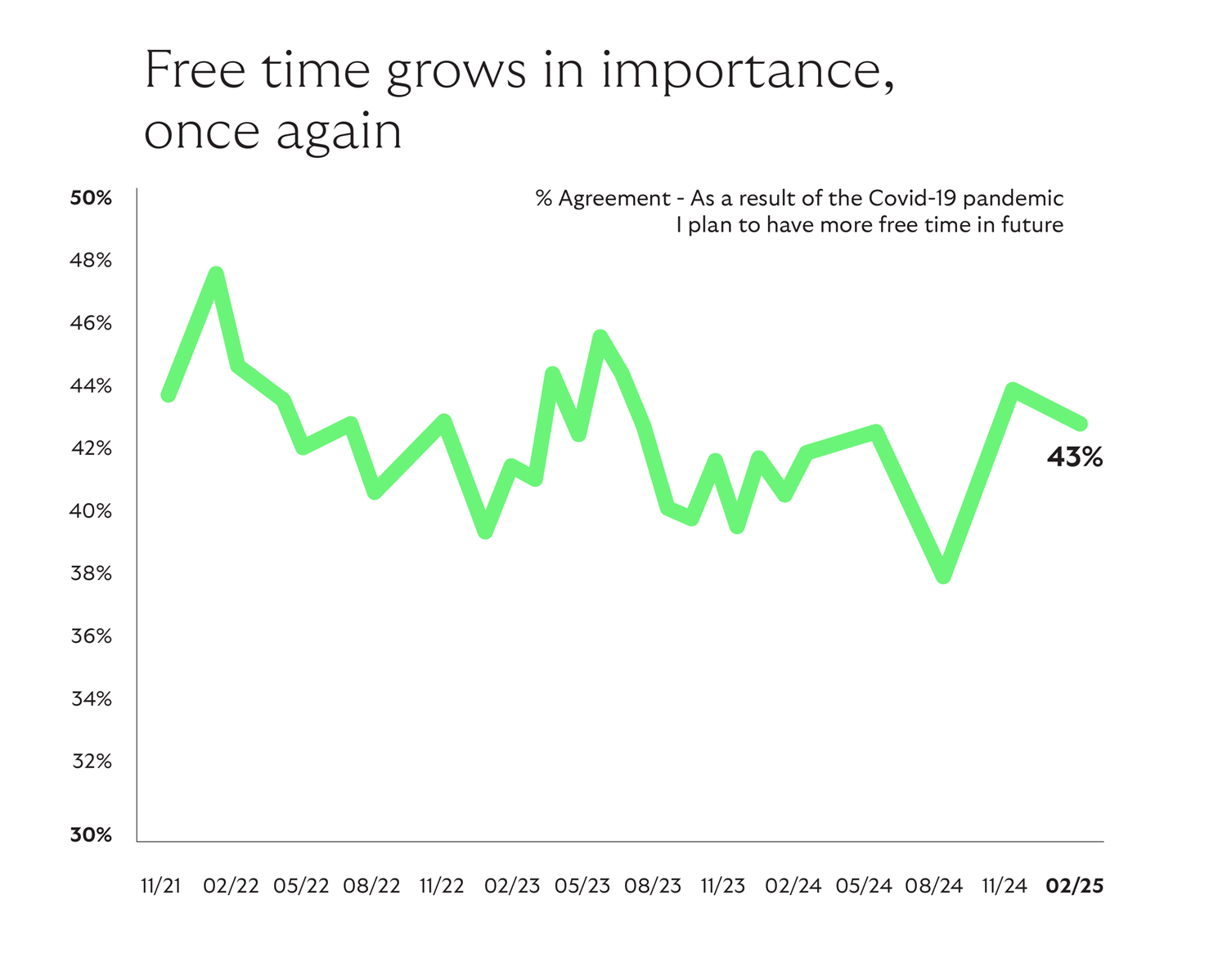
Since the pandemic, people value personal time more than ever. Many have adjusted their work-life balance by working less or opting for flexible schedules that fit around their lives.
This shift means more people are enjoying a slower pace of life – mostly inspired by previous pandemic restrictions. However, this trend is mostly seen among the financially secure, who can afford to work less and focus on family time.
Around 4 in 10 consistently aim for more free time, a trend likely to continue. Free time is highly valued, with many favouring staying at home over participating in out-of-home activities.
We’re shifting to slower living, staying in more and cutting back on social outings. This is reflected by the 74% of UK adults that choose to spend their free time relaxing at home.
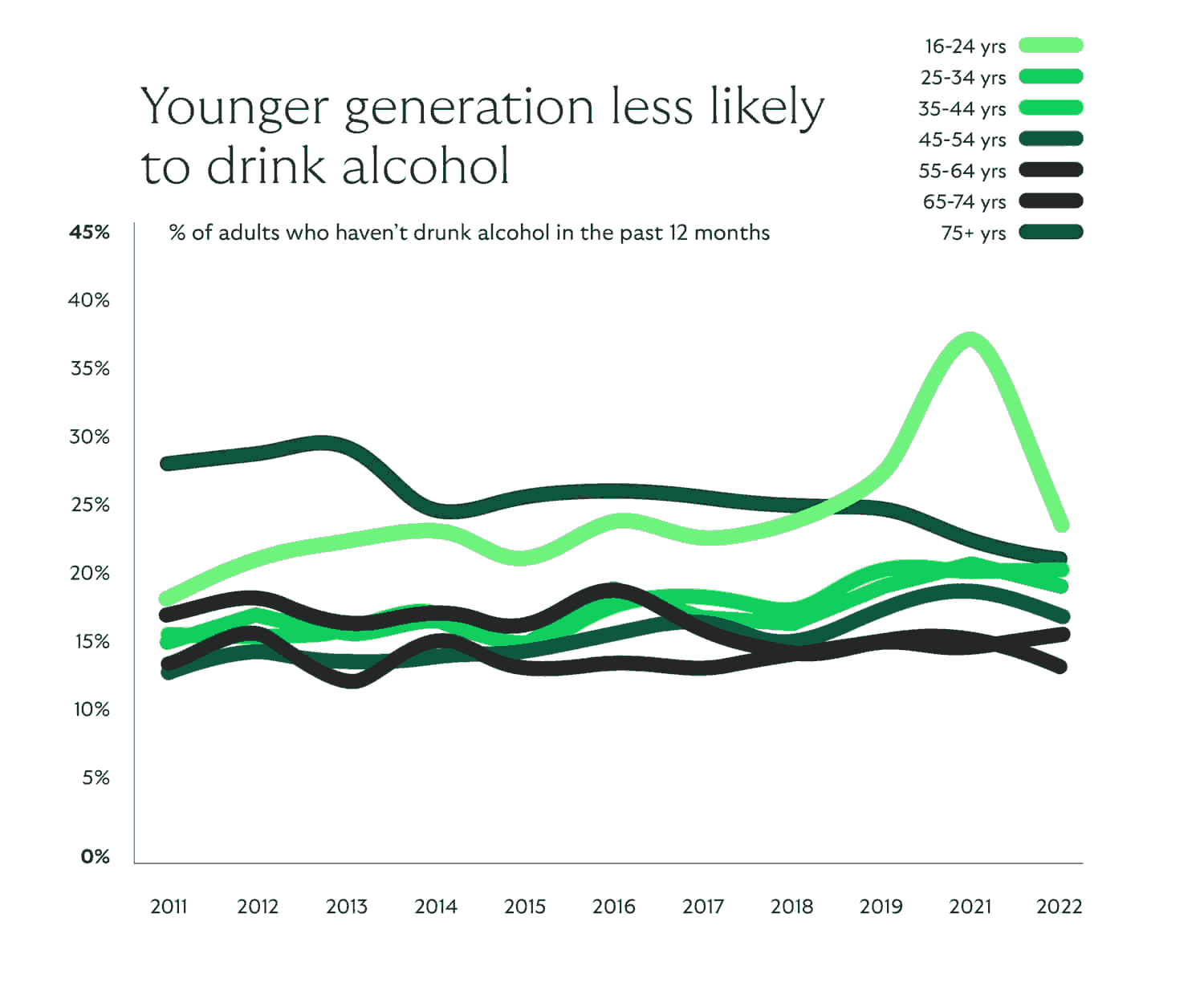
Growing media influence on unhealthy products and government efforts to prioritise individual wellbeing began to shift our outlook on health.
Many of us are making healthier lifestyles choices, with lower alcohol consumption and more focus on fitness and sports. Gen Z are maxing out at the gym; 30% regularly work out compared to only 15-25% of all adults. For £100,000+ earners, finding the time to train seems to be an issue, with 51% saying they’d work on health and fitness if they had more free time.
Healthy is becoming the new happy hour: from clean eating to weekend hikes, daily routines are getting a glow-up – and, again, it’s Gen Z leading the charge, swapping pints for Pilates and pub crawls for cold-pressed juice.
Technology has transformed our lives by making everyday tasks faster, communication instant and access to information limitless. Being able to connect globally, shop quicker and keep in touch easier, has shifted our everyday habits.
With tech advancements, these activities are expanding, blending in-home and out-of-home leisure into new experiences and audiences. Around half of us spend time in the 'Fourth Place' – a digital space that recreates real world leisure, through gaming, culture experiences and exercise.
The 'Fourth Place' will subtly shape our daily life, from virtual movie nights to video calls. As AR and VR advance, new ways to engage in digital leisure will emerge, diversifying how we spend free time and impacting traditional out-of-home activities.
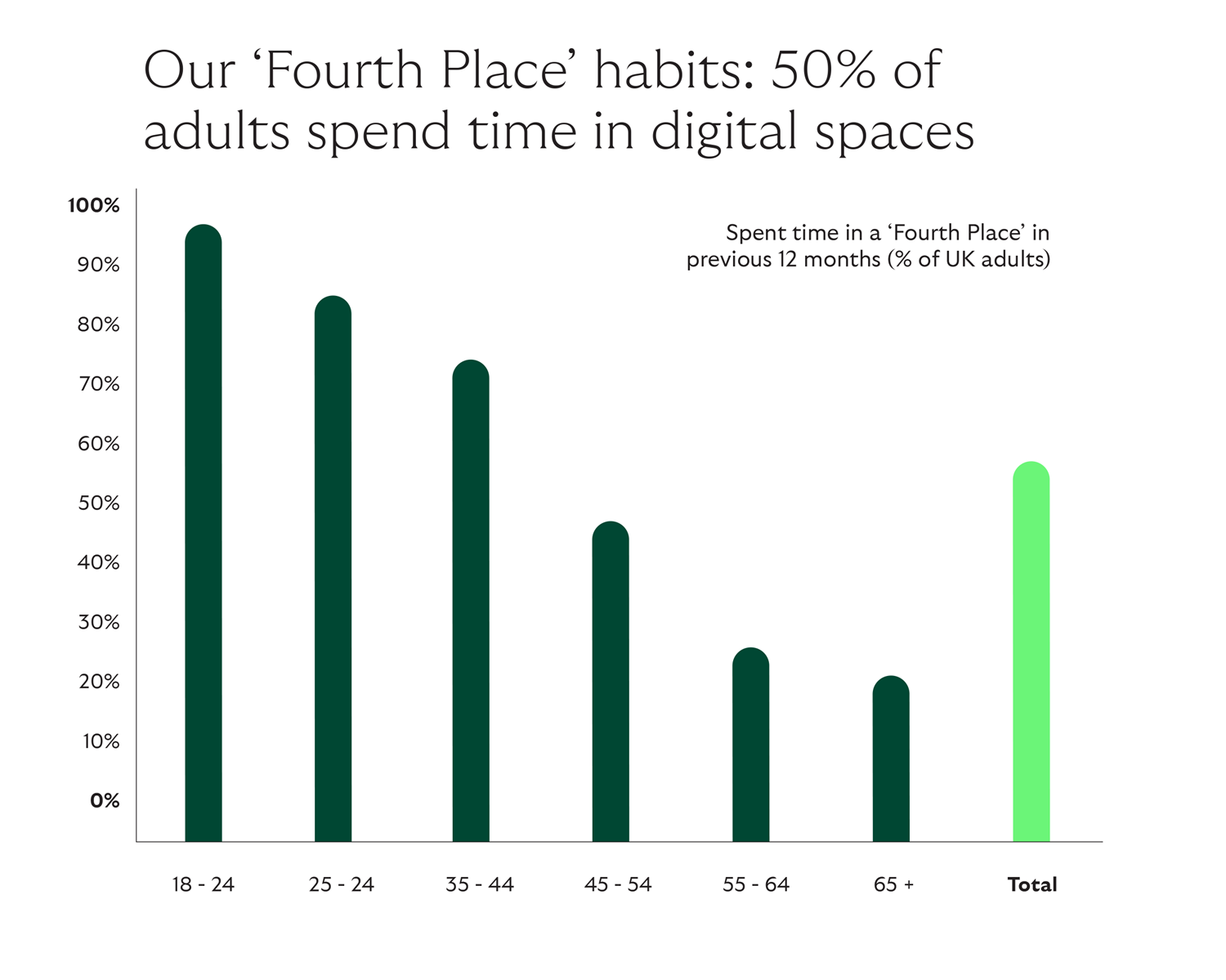
Social time became less frequent, so quality started to matter more than ever before. As such, how we spent our free time became more determined by its value.
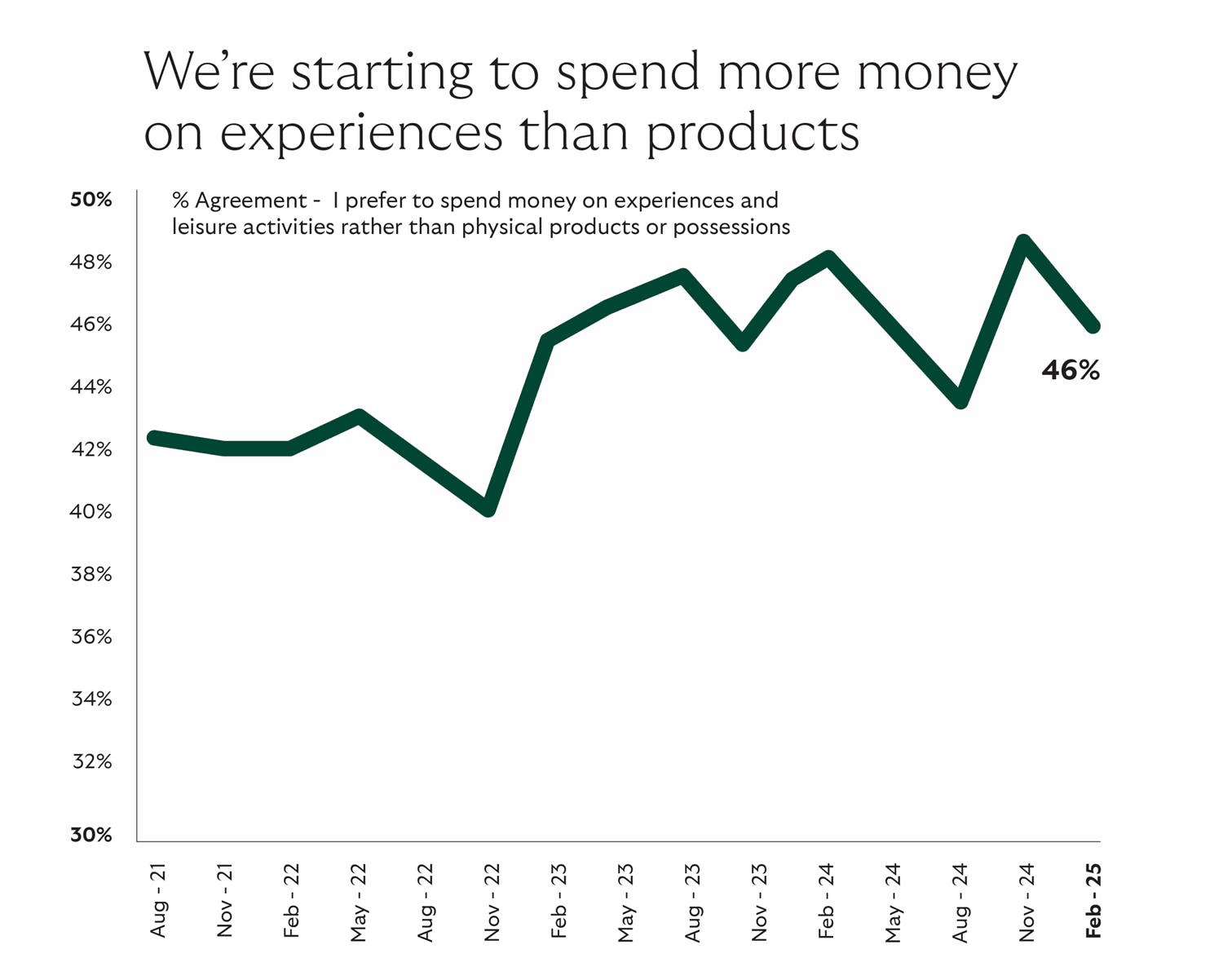
More casual socialising, such as after work drinks, is seen as less important, with one-off experiences becoming more enticing. As a result, many of us also prefer to spend money on experiences and leisure activities rather than physical products or possessions.
Experiential leisure will stay popular, from concerts to activities like escape rooms and themed bars. Holidays, often more luxurious, will remain a priority and sharing experiences via social media will continue to be a noticeable trend. Creating time for experience will be key, with 53% of £100,000+ earners saying they would spend extra free time travelling.
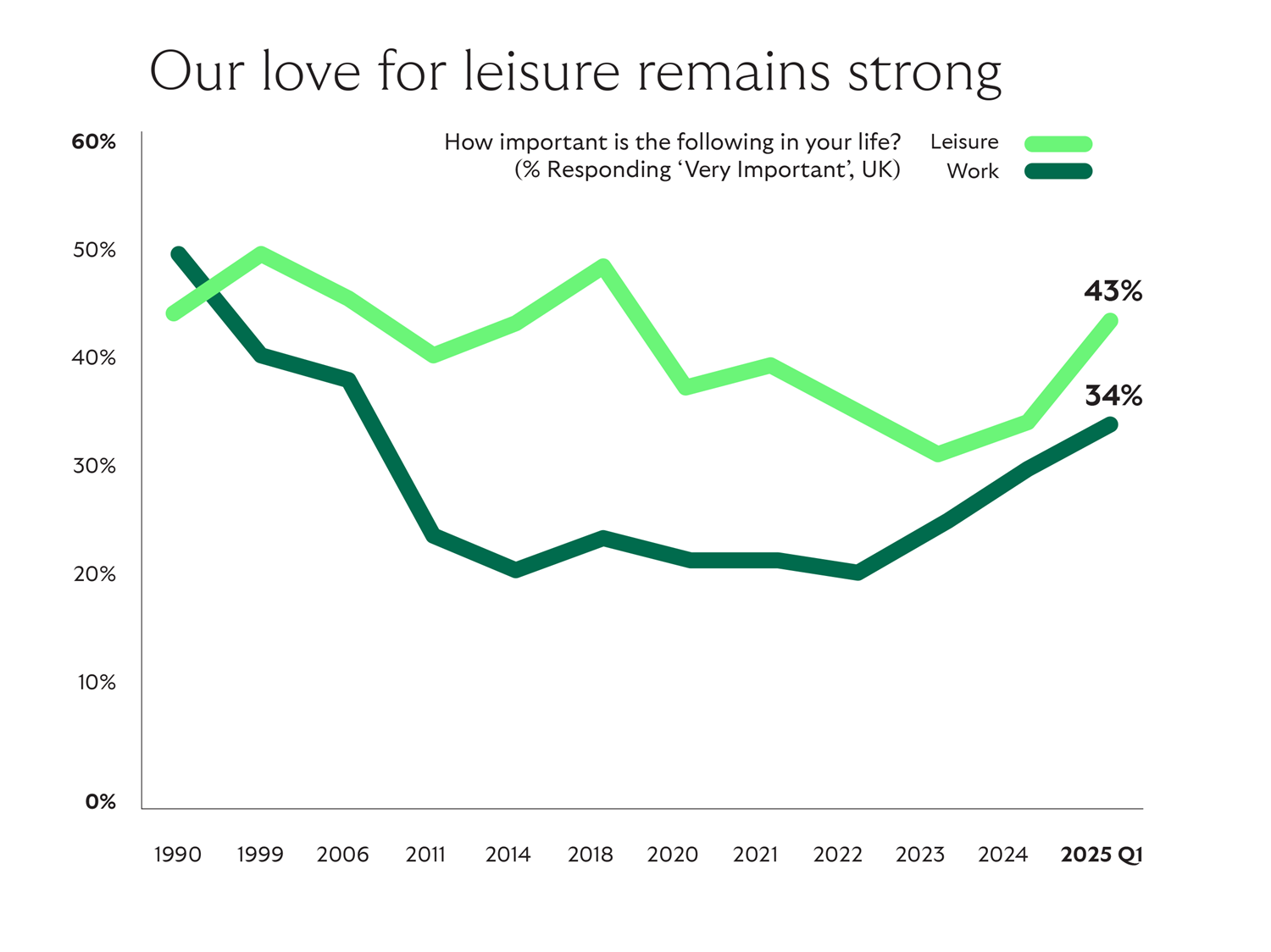
For over 30 years, leisure has been a bigger priority than work for most Brits. Even during the cost-of-living crisis, where the gap narrowed as work gained importance, leisure still had the upper hand, as people searched for creative, affordable ways to enjoy their free time.
People are approaching leisure time differently: some prefer more frequent, low-cost activities, while others choose fewer but higher-quality experiences.
Tech won’t just save us time, it’ll upgrade how we spend it. At home, it’ll offer affordable activities and ways to connect globally. While outside, it’ll create immersive experiences, from high-tech concerts to social gaming adventures.
Technology plays a pivotal role in helping us to claim back our free time. 60% are likely to adopt new tech to save time in the future… But what will this look like?

Good news for the 56% of £100,000+ earners who want their own AI assistants to help coordinate diaries, book restaurants and plan itineraries. Personal AI assistants are set to get even better at ‘using computers’ just as humans do, meaning they can reduce admin load for things like this.

Drones are getting smarter, faster and more independent. Autonomous flight, swarm intelligence, predictive maintenance and longer battery life are making missions quicker and safer.
As regulations evolve and obstacle-detection improves, drones will soon soar beyond the pilot’s line of sight.

Autonomous vehicles (AVs) are shifting from niche to mainstream. Goldman Sachs predicts that by 2030, 10% of new vehicle sales will be partially autonomous cars. However, people are approaching with caution – just 10% of UK adults are currently open to using an AV to save time.

Healthcare is going digital… and fast. From patient care to admin, it's saving time for professionals and the public alike. Wearable and non-wearable health technology is the number one emerging technology category that UK adults say they’d be open to using to manage day-to-day life and save time.

Keeping the house in order is the number one time thief from UK adults, with 47% saying household chores is where their free time is being lost. And there is a need for a solution, with 59% of £100,000+ earners wish they could spend less time cleaning and tidying, 42% want smart vacuums and 49% want smart kitchens.

Tech is stepping in to give us our time back. From virtual property viewings to AI-powered learning, the future is all about doing more while doing less. Efficiency is no longer just a luxury; it's built in.
The digitisation of everyday life will change a whole plethora of industries.

When it comes to the digitalisation of life, UK adults are almost twice as likely to use banking apps (48%) to manage their day-to-day life and save time than the second most used technology, shopping apps (25%).
Let’s fast forward to 2030. What could you be doing with your extra free time?

Age: 46
Lifestyle: Working mother of two, married
Location: Peak District
Job: Head of data for a Manchester-based tech firm

Age: 27
Lifestyle: Dating, full-time worker
Location: London, living with two housemates
Job: Account director for a London-based marketing company
21 May 2025 | Jo Harris
We're revolutionising financial management for customers with incomes of £100k+. Discover personalised, mobile-first banking solutions designed to simplify complex financial decisions, offer expert guidance, and provide exclusive rewards.
14 March 2025 | Rohit Dhawan
Artificial Intelligence will revolutionise the financial services industry over the coming decade. And the transformation will be broad – impacting everything from customer experience to administrative operations.
This is your window into the dynamic landscape of large-scale digital transformation. Each fortnight we invite industry leaders and experts to explore the latest trends, insights and stories shaping modern tech.
Popular topics you might be interested in