Imagine you get a call from your Head of Department. They've seen an exciting new AI capability and see the potential to improve the experience you offer customers. You’re excited too. But as you’re asked to explore bringing the idea to life, questions quickly follow: What could go wrong? How do you know the technology will perform as intended? What safeguards do you need? And who remains accountable? These are questions many organisations are grappling with as they adopt and scale AI. 

This is where Responsible AI comes in. 

Responsible AI (RAI) brings together the governance, risk management, human oversight, technical controls, monitoring and assurance needed to adopt AI with confidence, while retaining the trust of customers, colleagues and wider society. It helps organisations consider not only whether an AI system works, but whether it is appropriate for its intended purpose, who could be affected, what could go wrong and who remains accountable for the outcome.   

Why is embedding AI responsibly so important?

1bn+

people globally actively use AI tools

28m+

UK adults now use AI to help manage their money

52%

of UK businesses are using AI. 

83%

of UK professionals use generative AI at work. 

RAI matters because AI can introduce or amplify risks that conventional technology controls may not fully address. AI models can generate inaccurate information, reproduce and amplify bias, be manipulated by malicious prompts or behave differently as data and operating environments change. Agentic AI brings further questions because systems may take sequences of actions, make decisions over time and interact with complex environments.

Lessons from Lloyds Banking Group’s Responsible AI journey

Why listen to us?

There is no single or finished model for Responsible AI. Our approach continues to evolve as technology, regulation and customer expectations change. Rather than offer another abstract set of principles, the guide shares four real examples from Lloyds Banking Group to show some of the practical lessons we have learned so far.

For Lloyds Banking Group, Responsible AI is an enabler of innovation. Our approach is to build on established enterprise governance and introduce targeted AI-specific controls where risks are novel or rapidly evolving. AI use cases are supported by a Group-wide AI governance and assurance framework, central visibility of AI deployments, ethical review for edge cases, independent oversight and practical tools for testing and managing risk.  

We are sharing these lessons from practical experience. Lloyds Banking Group was among the first UK banks to appoint a Head of Data and AI Ethics, and participates in initiatives like the FCA’s AI Live Testing sandbox. The Group was also ranked first for Responsible AI leadership in the latest Evident AI Index and received the 2025 DataIQ award for Best Responsible AI Programme or Initiative. 

Responsible AI involves establishing robust governance processes, introducing technical controls, testing assumptions and learning and evolving as the technology develops.

Artificial Intelligence at Lloyds Banking Group

Find out how we're investing in AI to transform customer and colleague experiences.

Visit the AI hub


Lloyds climbs global rankings for AI talent and leadership

We've maintained our position in the October 2026 Evident AI Index, retaining our ranking for a second consecutive year and remaining the highest placed bank in the UK. 

Read the press release

Invest AI: putting Responsible AI into practice

The starting point has to be the customer and whether AI can make a meaningful difference. Responsible AI brings customer outcomes, governance and engineering together from the outset. 

Sameer Gupta Group Chief Data & AI Officer

Invest AI is an AI investing assistant designed for everyday customers using the Scottish Widows app. It can answer questions about investing and provide general guidance, while staying on the right side of the important boundary between guidance and personalised financial advice.  

For the development team, this created a very practical challenge. How could the team help create something genuinely useful for customers while anticipating the ways an Agentic AI assistant might behave differently from what its designers intended? 

Part of the answer was to involve Responsible AI from the beginning.

While the use case team owned the risk management of Invest AI, the Responsible AI team worked alongside the Invest AI team and specialists from risk, behavioural science, security and other relevant disciplines. Together, they explored what could go wrong, translated those risks into safeguards, tested those safeguards rigorously and designed how the system would be monitored after launch.  

The experience produced a practical model that other organisations may find helpful to refer to when developing customer-facing AI.

Launching Invest AI was a genuine partnership, bringing together our shared commitment to innovation, responsible AI and good customer outcomes. Working closely with the Responsible AI team, Risk and Control partners, we embedded controls into the design from the outset, enabling us to deliver customer-facing AI investment guidance within a regulated firm, with safety and consumer duty central to our approach.

Babatunde Akinkugbe Technology Platform Lead

Evaluating a third-party AI

AI has the potential to make customer service more efficient, including through voice assistants that can answer questions and help customers complete servicing tasks. But a natural-sounding conversation is not enough to establish that a system is reliable. Organisations need evidence that such systems can interpret customer requests accurately, provide reliable information and recognise when a person needs support from a human agent. 

Lloyds Banking Group put these principles into practice when it explored the potential use of an AI assisted booking agent developed by one of its external partners. The system was designed to support voice and text conversations, retrieve information about products and policies, and use defined tools to carry out servicing tasks where those capabilities are enabled. 

The assessment needed to consider more than the quality of individual answers. A misunderstanding early in a voice conversation could affect the information retrieved, the response given or, where permitted, an action taken on a booking. Responsible AI Specialists worked with the business and provider to understand these risks and gather evidence to inform the proposed use. 

As the first voice AI agent use case considered by the Group, the proposal was referred to its  Group’s Data & AI Ethics Committee. Questions of anthropomorphism and potential bias were explored. The committee determined that Responsible AI Specialists would support an exploration of the use case and conduct a risk assessment of the provider’s proposed solution. This created an opportunity to examine the technology before deciding which capabilities, if any, would be appropriate to enable. 

The provider’s documentation, evaluation results and guardrails were reviewed through a series of detailed engagements. These were important starting points, but descriptions of testing and controls were not treated as sufficient evidence on their own. The team requested results, clarification of testing methods and further evaluation where gaps remained.


Moving from claims to evidence

Two key questions in the Responsible AI assessment included:  

  1. Could the assistant reliably understand requests, provide appropriate answers and support the intended customer journey? 
  2. Did performance vary across different ways of speaking, audio conditions and customer intents, and could customers reliably reach a human agent? 

The risk assessment considered the speech-to-text component, the language-model agent, the knowledge-retrieval process and the overall system. Direct access to individual components was limited, so the practical evaluation analysed complete conversations to assess the quality and safety of the proposed customer experience. Each conversation was assessed across 14 performance and safety metrics, ranging from detecting toxic content to determining whether the assistant successfully resolved the customer’s request. 

Rather than relying on one overall performance score the evaluation used several methods to look for differences between customer groups and operating conditions:

  • Generating synthetic customer conversations: Large language models (LLMs) acted as customer personas to conduct synthetic conversations with the assistant, generating a large dataset containing thousands of conversations. These covered different customer intents, UK accents, gender, audio quality, call scenarios, speaking speeds and speech volumes, including background noise and speakerphone conditions. 
  • Disparate Impact Ratio (Adverse Impact Ratio / AIR): For each evaluation metric, this measure compared a group’s pass rate with the highest pass rate among the groups being compared. Calculating separate ratios across UK accents, customer profiles and call conditions helped identify where conversations were less likely to meet the same performance or safety standard. A lower ratio indicated a larger relative shortfall, providing a signal for investigation rather than proof of unfairness or its cause. 
  • Cramér’s V and Chi-squared Test: Cramér’s V measured the strength of the association between a customer group or call condition and each metric’s pass/fail outcome. The chi-squared test assessed whether the association was statistically significant, helping determine whether the observed differences could be explained by random noise or suggested a potentially more systematic pattern in the system’s performance. Together, they helped identify potentially systematic performance gaps requiring further investigation. 
  • Stochastic Bootstrapping: This method estimates uncertainty by calculating metric values across a large number of randomly sampled batches, drawn with replacement from the synthetic conversation data generated during the pilot. 

The evaluation of these synthetic conversations identified weaker performance with background noise or low speech volume. These findings highlighted practical risks that an average performance score alone would not reveal, including whether customers could reliably access human support when needed. 

The team also needed to recognise what the evidence could not establish. Simulated conversations provide controlled comparisons, but cannot represent every real customer or operating condition. With limited visibility into individual components, an observed difference in the overall conversation did not, by itself, establish its cause. Findings therefore needed to be interpreted alongside the testing design and followed by further investigation and plans around monitoring.


Assessing reliability across UK accents and call quality

A specific focus of the bias work was whether the solution could work reliably across different UK accents and levels of call quality, including background noise, low speech volume and speakerphone conditions. For a voice assistant, fairness is not only about the wording of its answers. It also means examining whether differences in how customers speak or the conditions of their call affect the system’s ability to understand them and support their requests. 

The team examined performance across the UK accents included in the evaluation, looking beyond the overall score for differences that could indicate an uneven customer experience. The aim was to determine whether reliability depended on a customer’s accent or call quality, rather than assuming that strong average performance meant the assistant would work equally well for everyone. 

This made accent and technology-related bias a practical question of trust and service quality. If an assistant misunderstands some ways of speaking or struggles under certain call conditions more often, customers may need to repeat themselves or struggle to complete the same request. The analysis provided evidence about the specific accents and conditions tested, rather than proof of performance across every customer or real-world environment.

Testing without unnecessary exposure of customer information

For this use case, AI customer personas generated synthetic conversations with defined goals and communication styles, enabling controlled, repeatable testing while reducing the need for personal customer information. 

This also enabled potential failures to be identified without exposing real customers, although simulated conversations could not replace evidence of real-world performance. 

Responsible assurance means using generated data or restricting access where appropriate, while keeping testing relevant to the people and situations the system will encounter. There is often no silver bullet and a staggered approach can provide an answer. 

Being prepared to act on the findings

Findings were shared with the external provider and recorded in the risk assessment, informing guardrails needed while balancing risks and benefits. They also informed follow-up work with the provider on the performance gaps identified. 

The evaluation was designed to inform the decision and tool configuration, rather than validate a decision already made. 

Responsible AI assurance should lead to action: investigating concerns, reconsidering the proposed use and working with relevant parties to address them. 


Responsible AI has moved beyond principles; now we need to make it work at scale

Suzanne Brink and Alice Genevois | 18 November 2026

How can organisations scale Responsible AI? Explore practical lessons on AI governance, human oversight, monitoring and embedding responsible AI across the AI lifecycle.

Read their article

Artificial Intelligence at Lloyds Banking Group

Find out how we're investing in AI to transform customer and colleague experiences.

Visit the AI hub

What other organisations can learn

  • A system can be technically operational without consistently supporting the customer journey. Provider testing is important, but performance may vary with the channel, request, communication style and environment in which the technology is used. 

    For a voice assistant, that means looking beyond the quality of written answers. The bias assessment tested for differences in performance across the UK accents included in the evaluation. The wider evaluation also explored how audio conditions and customer intents affected the conversation, including whether requests for human support were handled successfully. 

    An overall score can conceal important differences. Comparing results across relevant scenarios helps organisations understand who may encounter a weaker service and which parts of the journey need attention. 

    Takeaway: define success for the complete customer journey, use more than one measure and compare performance across realistic conditions. Test the functions you intend to enable, rather than assuming evidence for one capability applies to all others.

  • Synthetic conversations make controlled testing possible, but do not capture every real-world situation. Limited access to a third-party system can also make it difficult to isolate the source of an error. Neither limitation removes the need to investigate a weaker customer outcome. 

    Takeaway: report what was tested, what remains uncertain and what the results cannot establish. Distinguish an observed performance gap from a proven cause, and complement controlled testing with appropriate monitoring of real interactions. 

  • Human escalation is only a meaningful safeguard if customers can use it successfully. Likewise, a provider’s wider product capabilities should not be confused with the functions assessed and permitted for a particular deployment. 

    Takeaway: test requests for human help explicitly, use findings to address weaknesses and reassess risk when capabilities change. Treat proposed actions as a distinct assurance question, not simply an extension of answering FAQs.

  • Responsible AI isn’t about proving that a preferred technology is safe to use. It is about gathering enough evidence to decide whether, where and how it should be used.  

    For a customer facing voice AI assistant, that means examining the complete conversation, understanding how errors can pass between components, protecting customer information and checking that human support is genuinely accessible. Offline testing with synthetic data should simulate realistic customer–AI interactions using defined customer personas, varied customer demographics and different technology conditions, such as devices, audio quality and background noise - not just example question-and-answer datasets.  

    It also means acknowledging the limits of simulated testing and using findings to shape safeguards and the permitted scope. Where a system is deployed, monitoring of real life interactions remains critical.  

    The standard should not simply be whether an AI assistant sounds convincing or handles most queries. The more important question is whether there is sufficient evidence that its specific proposed use is responsible, appropriate and in the interests of the people it may affect. 

    Testing should inform the decision, not simply confirm one already made.  For Lloyds Banking Group, that is an important part of being deliberate about where AI can genuinely improve an experience and where it should not be used. 

We know we can, but should we?

How Lloyds Banking Group considers novel ethical questions about data and AI

Sometimes an AI use case can be legally permissible and technically possible, but still the use case can raise the question:  

We know we can do this, but should we? 

That’s the question that sits at the heart of Lloyds Banking Group’s Data & AI Ethics Committee. 

The committee provides a formal decision-making forum for novel ethical dilemmas involving data and AI. It’s not intended to review every AI risk or use case because established risks such as hallucination and bias can often be managed through existing governance, safeguards and controls.

Instead, the role of the committee is to focus on ethical edge cases that the Group hasn’t considered before, and where an existing decision or precedent can’t provide a clear answer.  

The question isn’t only whether we can use AI, but whether we should. Being responsible means thinking beyond what is technically possible and asking whether a use of AI is right for our customers and something we’re prepared to stand behind.

Suzanne Brink Head of Responsible AI

Why is an ethics committee necessary?

See why

How does the Data & AI Ethics Committee work?

See how

What kinds of questions reach the committee?

See what

Who needs to be involved?

See who

How does a committee like this support Responsible AI at scale?

See how it supports RAI

Does every organisation need an AI ethics committee?

See the answer

Five lessons for other organisations


  • Lesson one

    Define what requires ethical escalation 

    Not every AI risk is a novel ethical dilemma. Bias, hallucination and other recognised risks may be mitigated by established controls and governance frameworks. 

    Create criteria that help teams distinguish between: 

    - a known AI risk with an established control; 

    - a new application with an existing ethical precedent; 

    - a genuinely novel ethical question requiring escalation. 

    Takeaway: reserve senior ethical review for questions that cannot be resolved through existing policy, guidance or precedent

  • Lesson two

    Separate ‘legal’ from ‘ethical’ 

    Legal approval doesn’t automatically establish that a use case aligns with an organisation’s values, but keep in mind that the ethical question is not there to compete with or override the legal question – rather, to address the challenges that legal alone can’t answer. 

    Because of this, a distinct ethical question should be added to the review process: 

    ‘If this is lawful and within risk appetite, are we still comfortable using it in this way?’ 

    Takeaway: make ethical acceptability an explicit decision rather than assuming it is covered by legal or risk approval. 

  • Lesson three

    Combine diverse input with accountable decisions 

    Ethical questions benefit from different professional and personal perspectives, but the final decision also needs clear accountability. 

    Create a process that allows specialists, business representatives and people with different perspectives to contribute, while giving a named person or forum authority to decide. 

    Takeaway: broad participation and executive accountability serve different purposes. Responsible, ethical governance needs both. 

  • Lesson four

    Give the forum meaningful authority 

    An ethics committee should be able to influence what happens next. At Lloyds Banking Group, the committee can allow a use case to progress, recommend safeguards, or decide that it shouldn't proceed if it doesn’t align with organisational values.  

    Before establishing a forum, define the decisions it can make and whether its recommendations are binding.  

    Takeaway: an ethics forum without decision rights risks becoming a discussion group rather than an effective part of governance to enable responsible innovation.

  • Lesson five

    Turn decisions into reusable guidance 

    The value of an ethical decision should extend beyond a single project. Record the decision, the reasoning behind it, the guardrails required and the limits of the precedent. Use that learning to create guidance for teams considering similar use cases to create scalable best practice patterns. 

    Takeaway: the aim isn’t to send every AI project to a committee; it’s to create clearer ethical parameters so future projects can move forward responsibly and confidently. 

The central lesson 

The purpose of the Data & AI Ethics Committee is to create a clear, accountable route for the questions that existing governance cannot answer on its own. It can help an organisation explore innovative and novel uses of AI while remaining clear about its values, safeguards and ethical boundaries. 

The most useful question for other organisations is therefore not simply, ‘Do we need an ethics committee?’ 

It’s: 

When an AI use case is legal and technically possible, who decides whether it is also the right thing to do? 

Enterprise guardrails: Making the responsible choice the easy choice

How Lloyds Banking Group combines risk identification, guardrails and human expertise to manage evolving AI risks

Despite careful design, an AI model may generate inaccurate information, reproduce stereotypes, use inappropriate language or be manipulated into doing something it wasn’t designed to do. Identifying these risks through a Responsible AI framework is important, but organisations also need practical ways to detect and manage them while systems are operating. 

At Lloyds Banking Group, our Responsible AI and AI development teams work together to evaluate emerging risks and develop appropriate mitigations. We treat AI safety as a continuously evolving capability, combining guardrails, AI safety tools, use-case-specific controls, monitoring and human expertise. 

Guardrails are reusable technical controls designed to address defined AI risks. Making them available across the enterprise reduces duplicated effort and helps teams apply controls consistently, while still allowing teams to assess and test how those controls work within each specific use case.

Responsible AI has to work at scale. That means translating governance into practical controls we can engineer into the way AI is designed and built, while continuing to learn and adapt as the technology and risks evolve.

Rohit Dhawan Group Head of Artificial Intelligence

From a risk definition to a working control 

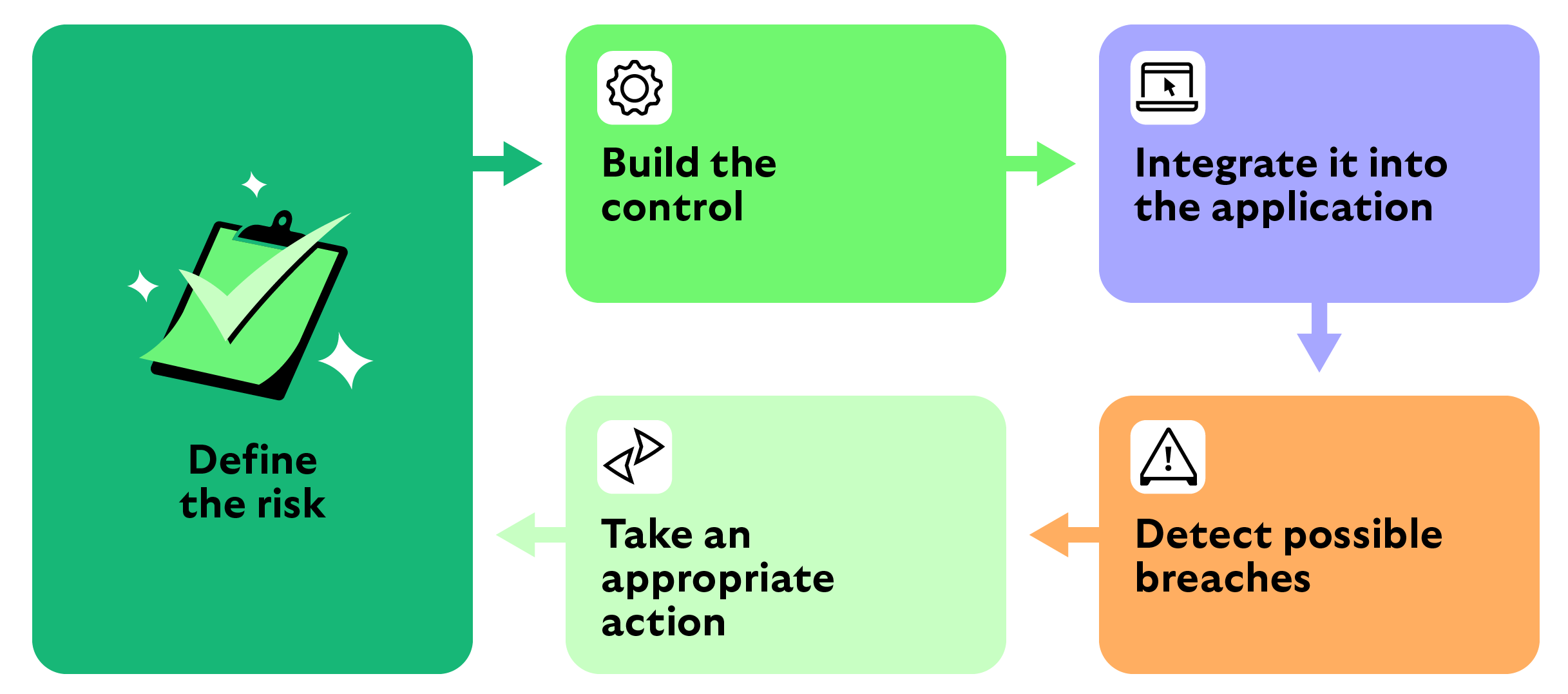
Effective controls start with a shared understanding of the risk. Risk taxonomies define the risk and its subcategories, with subject matter experts agreeing what acceptable and unacceptable behaviour looks like. This provides a common language for designing and testing controls. 

For example, an assurance process may identify hallucination as a material risk: a conversational agent could generate a plausible but fabricated answer when it lacks the information needed to respond. A hallucination guardrail can assess the proposed response for potentially unsupported information before it reaches the user. 

Guardrails can assess both incoming requests and outgoing responses, adding safeguards rather than relying on the model alone to behave as intended. But the right mitigation is not always a guardrail. It may involve changes to system design, deterministic controls, access restrictions, model configuration or human oversight.

Diagram showing a five-step process for managing AI risk: define the risk, build a control, integrate it into the application, detect possible breaches, then take appropriate action.

Testing controls in context 

A guardrail cannot be judged by detection accuracy alone. Its effectiveness also depends on speed, cost, user experience, risk tolerance and how it works alongside other safeguards. 

A control that detects issues but significantly delays responses may be unsuitable for a live customer interaction. A faster control that misses material risks may also be unacceptable. Success criteria should therefore reflect the use case, including the consequences of missed risks, incorrectly blocked content and uncertain results. 

Agentic AI adds another dimension. Controls may need to assess not only individual inputs and outputs, but also sequences of actions and autonomous decisions. The whole system must be tested with its controls in place, rather than treating each safeguard as an isolated check. 

The solution cannot be purely technical. Our colleagues have a huge wealth of knowledge, domain knowledge and expertise, which we absolutely need when we design and build out guardrails.

Suzanne Brink


Making safeguards easier to adopt 

Embedding safeguards into the standard AI development pathway makes responsible development easier and more consistent. At Lloyds Banking Group, guardrail capabilities are available alongside access to foundation models through our AI gateway Cortex. 

Our approach combines: 

  • Enterprise guardrails for risks that recur across the organisation. 
  • Business- or use-case-specific controls for risks that depend on a particular context. 

Reusable controls provide a stronger starting point, but do not replace use-case-level risk assessment, testing, assurance or accountability. 

Principles guiding our approach:

The central lesson

Guardrails help turn Responsible AI principles into practical controls, but they are not a substitute for governance, human judgement or assurance.

Their value comes from being clearly defined, tested in context, continuously monitored and used alongside other safeguards. Making them reusable and embedding them into AI delivery helps organisations adopt AI responsibly at scale, while continuing to adapt as risks evolve. 

A practical guardrail checklist 

Before introducing an AI guardrail, ask: 

Purpose

Purpose

  • Is the risk clearly defined? 
  • Is the guardrail intended to prevent, detect or help respond to that risk? 

Context

Context

  • Has the guardrail been assessed against the organisation’s language, customers, policies and risk appetite? 
  • Does the use case require a shared enterprise control or a more specific local control? 

Expertise

Expertise

  • Have risk experts and technical teams agreed a common definition? 
  • Have relevant subject matter experts helped define acceptable behaviour? 

Evaluation

Evaluation

  • Has the control been tested for accuracy and speed? 
  • Have false positives and missed detections been considered? 
  • Has its interaction with other controls been assessed? 

Ownership and monitoring

Ownership and monitoring

  • Who owns the guardrail?
  • How will feedback and emerging risks lead to updates?

From individual use cases to Responsible AI at scale 

Responsible AI must be treated as an iterative capability, not a one-off exercise. As AI adoption grows and technology develops, organisations need to keep learning from real use cases, testing whether their safeguards work and adapting their approach as new risks emerge.

For Lloyds Banking Group, the next stage is to embed Responsible AI more deeply into the way AI is designed, bought, deployed and monitored. We’ll continue to explore the latest responsible AI techniques and strengthen our controls as risks and technology evolve. 

The objective is to make it easier to innovate well, rather than to create governance for the sake of it. For Lloyds Banking Group, that means helping teams make responsible choices through clear governance, embedded assurance, practical controls and access to specialist expertise. It also means protecting customer trust while using AI to support better outcomes and our purpose of Helping Britain Prosper.

Organisations do not need to copy every element of our approach. But every organisation adopting AI should be able to answer the same fundamental questions: 

  • What outcome are we trying to improve and for whom?
  • What could go wrong and who could be affected?
  • Who is accountable for the outcome?
  • What evidence gives us confidence that the system is working as intended?
  • How will we detect and respond when that changes?

Being able to answer these questions consistently is what turns Responsible AI from a set of principles into a practical organisational capability, supporting innovation while protecting the people it is intended to serve.

Frequently asked questions about responsible AI

  • Responsible AI means designing, developing and deploying AI safely, securely and ethically. It combines governance, risk management, human oversight, technical controls and ongoing assurance to help ensure AI is trustworthy and accountable.

  • Responsible AI helps organisations realise the benefits of AI while managing risks to customers, colleagues and the organisation. It supports innovation by building trust, accountability and appropriate safeguards into how AI is developed and used.

  • Lloyds Banking Group’s approach to Responsible AI is centred on trust and accountability, fairness and inclusion, transparency and explainability, human oversight and safety, and sustainability and long-term value.

  • AI can create risks including inaccurate or misleading outputs, bias, data privacy and security issues, lack of explainability, malicious misuse and over-reliance on AI. More autonomous and agentic systems can introduce additional risks around unintended actions, loss of control and accountability.

  • Organisations should embed AI into established governance wherever possible and strengthen it where AI creates new or different risks. Governance should establish clear accountability, proportionate risk management, appropriate human oversight, testing, monitoring and routes for ethical challenge.

  • AI assurance is the process of identifying, assessing and managing AI risks throughout an AI system’s lifecycle. It provides evidence that appropriate safeguards and controls are in place, tested and monitored as the system is developed, deployed and used.

  • Agentic AI refers to AI systems that can plan, reason, use tools and take sequences of actions to achieve an objective. Their greater autonomy creates additional considerations around permissions, monitoring, auditability, human oversight and accountability.

  • Organisations can scale AI responsibly by making governance easy to navigate, applying proportionate controls, embedding safeguards into delivery processes and building Responsible AI capability across the organisation. As adoption grows, monitoring and assurance also need to remain effective throughout the AI lifecycle.

Responsible AI glossary


Related content

How is Lloyds Banking Group performing in 2026?

William Chalmers and Jas Singh OBE

As we publish our 2026 half year results and the next phase of our strategy, we continue to support customers and businesses, simplify how we work, and invest in the technology and skills that will define the future of financial services.

Read their article

Please note that this guide is intended as a helpful reference point rather than advice or a substitute for an organisation’s own legal, regulatory and risk assessment.

Page last updated: November 2026