Sustainability
We have an important role to play in creating a more sustainable and inclusive future.

We have an important role to play in creating a more sustainable and inclusive future.

Our report provides an update on how we are Helping Britain Prosper in a way that delivers long-term profit and returns.

We put you first, so you can put our customers first.
Our report provides an update on how we are Helping Britain Prosper in a way that delivers long-term profit and returns.

Disclosures relating to our strategic, financial, operational, environmental and social performance.

See all the key dates in the financial year.

Higher, more sustainable returns as we continue to Help Britain Prosper.

We've ranked in the top 10 employers for both graduates and apprenticeships in The Times Top 100.

We're searching for the best talent to join us in Leeds.

Join us as we explore new ideas and technologies to reshape the world of finance.
We have an important role to play in creating a more sustainable and inclusive future.
Our report provides an update on how we are Helping Britain Prosper in a way that delivers long-term profit and returns.
We put you first, so you can put our customers first.
Our report provides an update on how we are Helping Britain Prosper in a way that delivers long-term profit and returns.
Disclosures relating to our strategic, financial, operational, environmental and social performance.
See all the key dates in the financial year.
Higher, more sustainable returns as we continue to Help Britain Prosper.
We've ranked in the top 10 employers for both graduates and apprenticeships in The Times Top 100.
We're searching for the best talent to join us in Leeds.
Join us as we explore new ideas and technologies to reshape the world of finance.
Financial empowerment across the UK’s nations and regions

Money mapped explores how people across the UK use digital tools to manage money and pursue different financial goals. The findings show three overlapping pathways to financial empowerment: Progress through saving, investing and planning ahead; Stability through budgeting and financial control; and Resilience through managing everyday costs and reducing debt.
Drawing on insights¹ from Lloyds Banking Group’s Consumer Digital Index², Money mapped explores how digitally engaged adults across the UK's nations and regions ³, use digital tools ⁴, including AI, and how that use appears to be associated with financial behaviours, confidence and outcomes. Financial empowerment is defined as having the confidence, capability and control to make informed financial decisions.
This Spotlight focuses on people who are already online and should be considered alongside the wider Consumer Digital Index. It does not assess digital access or inclusion directly.
Look at a map of the UK and you see a rich variety of places, each shaped by its own economy, communities and ways of life. The same is true of how people manage their money, combining online and offline approaches and putting digital tools to work in different ways.
Yet beneath those differences, people are navigating many of the same financial questions: how to manage their money today, prepare for tomorrow, and make the most of what they have. Where people live can shape how those questions are experienced, and which tools they use to make their ambitions a reality.
Put simply, place matters.
Our second Spotlight brings those regional differences to life. Money mapped follows the evidence across the UK’s twelve regions and four nations, exploring how communities in each area use digital tools and AI, and how these technologies help achieve their financial goals.
Across the UK's nations and regions, people report different priorities, levels of confidence and financial outcomes. The report's central finding is that the biggest differences are not simply whether people use digital tools, but what those tools appear to help them achieve. Three broad and overlapping pathways emerge: Progress, Stability and Resilience.
The analysis reveals:
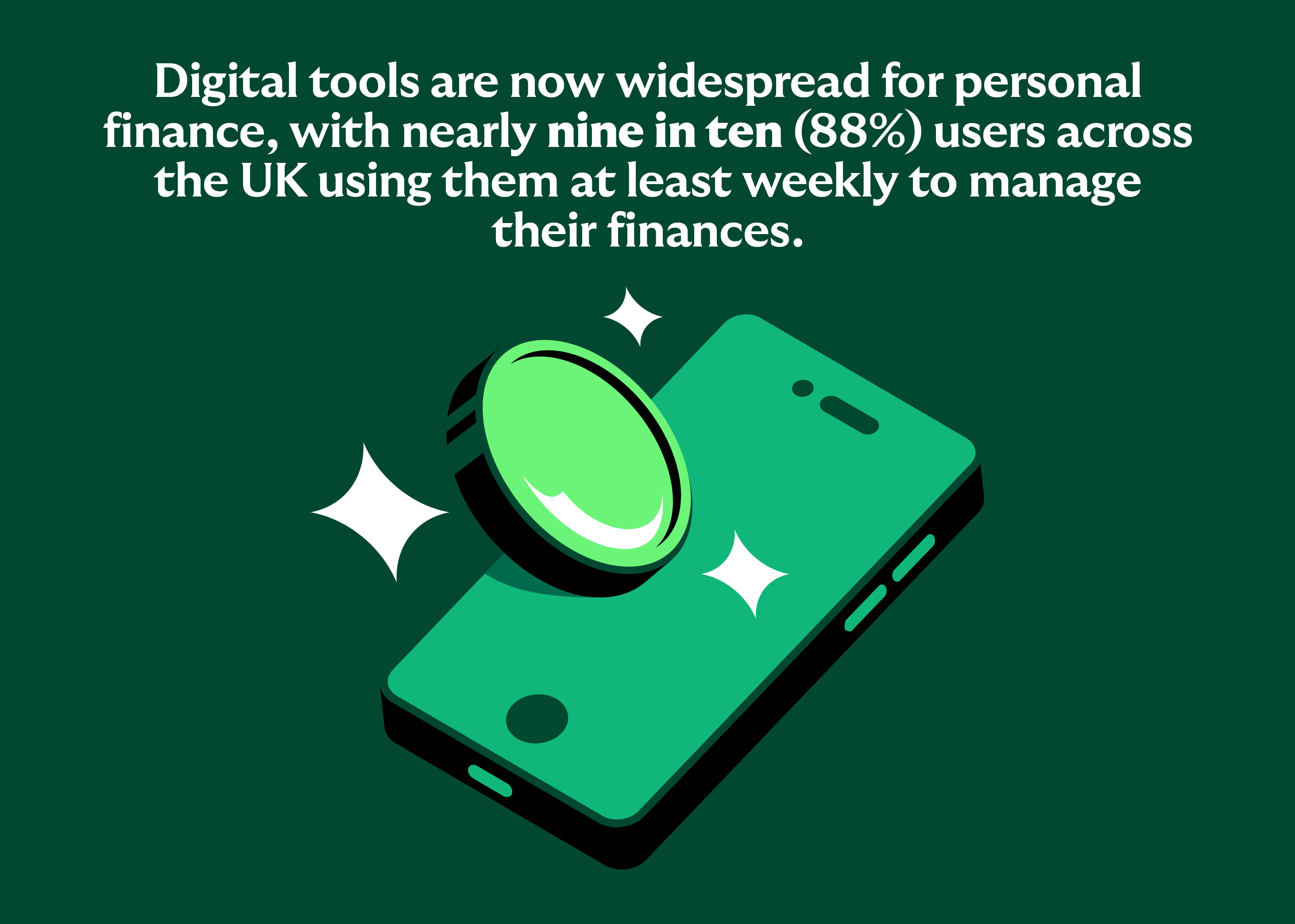
Digital tools are now widespread for personal finance with nearly nine in ten users across the UK using them weekly. However, different patterns emerge:
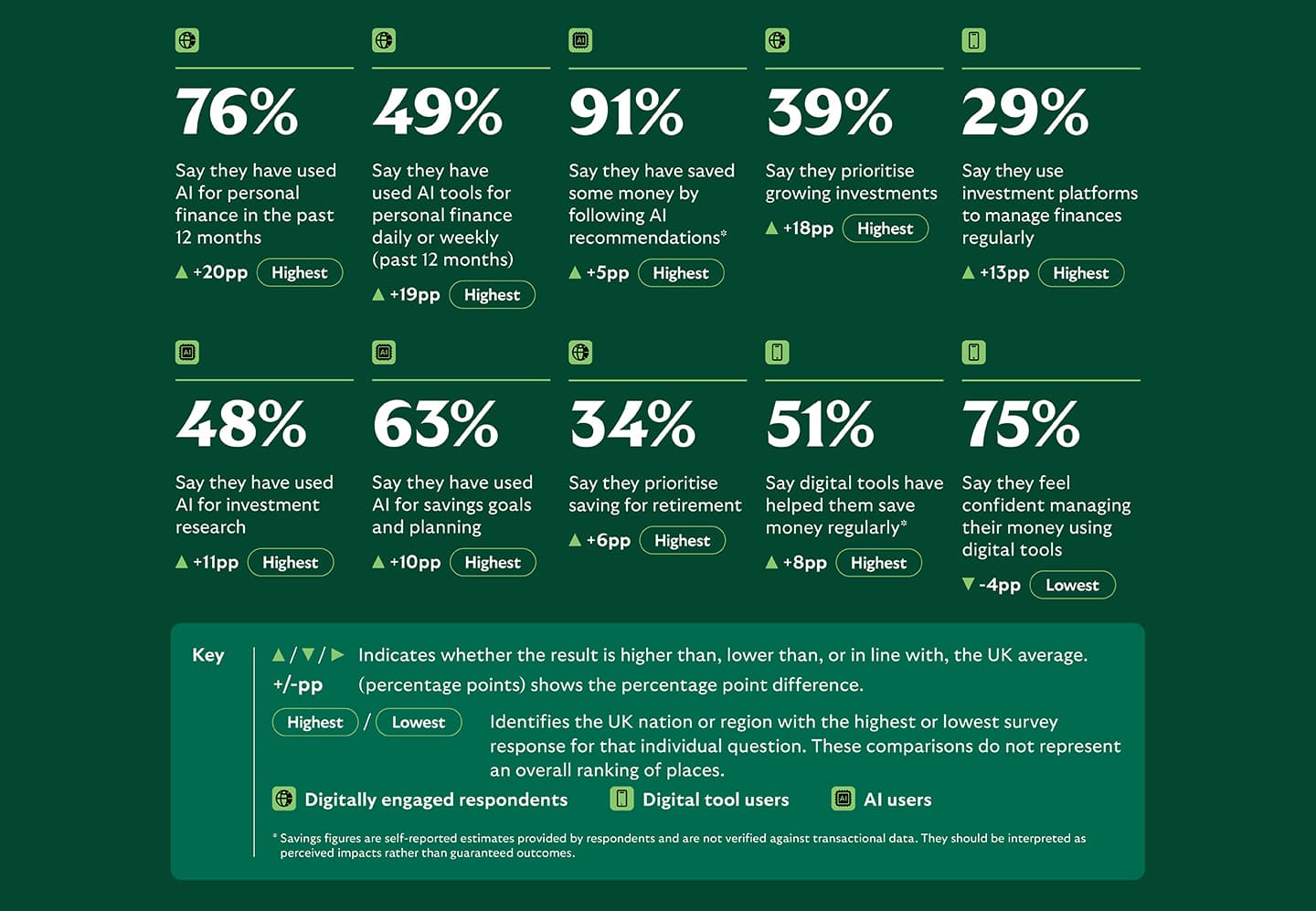
More than three-quarters (76%) of respondents in London have used AI for personal finance in the past year, while almost half (49%) use it daily or weekly.
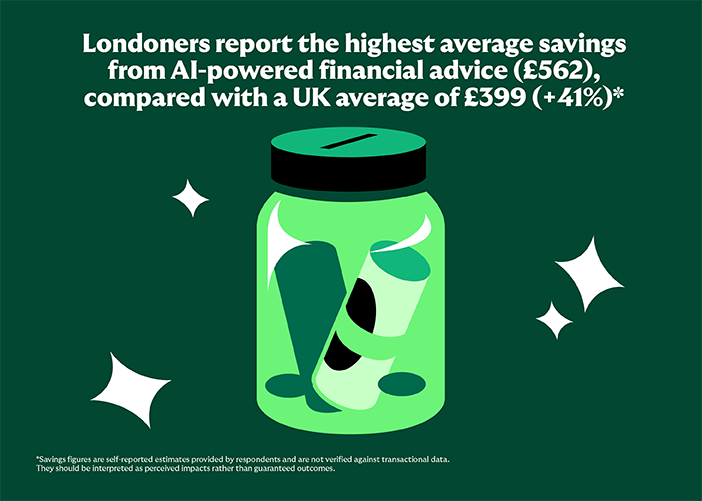
Among London AI users, 48% say they have used AI for investment research, and 27% report saving £600 or more after following AI recommendations, including nearly one in five (19%) who report saving at least £1,000. Londoners report the highest average savings from AI-powered financial advice (£562), compared with a UK average of £399 and £276 in the East Midlands.⁵
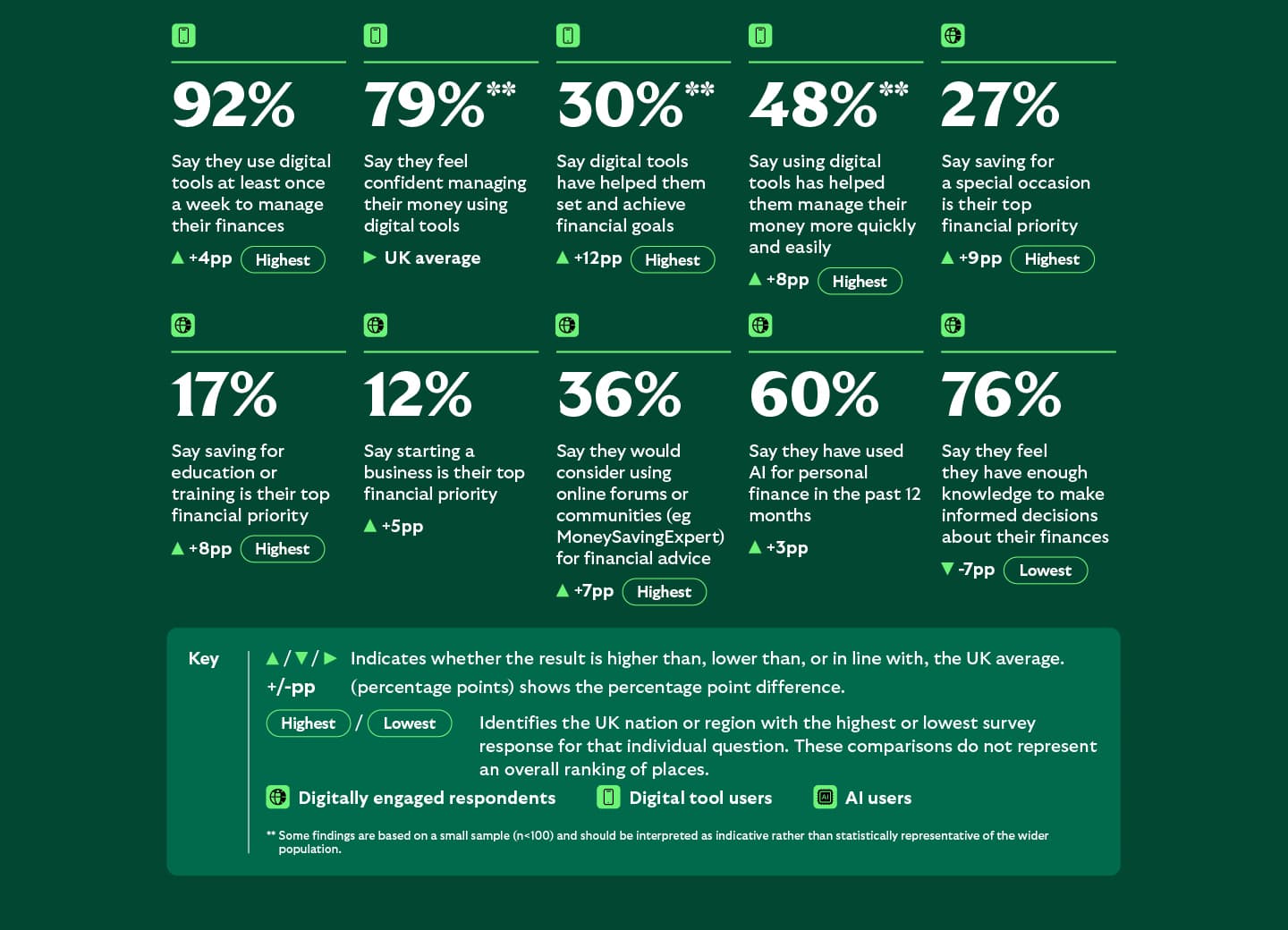
In Northern Ireland, 30%⁶ of digital tool users say digital tools have helped them set and achieve financial goals, the highest rate in the UK, despite respondents reporting the UK's lowest level of financial knowledge (76%).
Meanwhile, Scotland records the UK's highest confidence in managing money digitally (83%), while London records the lowest (75%). Together, the findings suggest financial knowledge, confidence and outcomes do not always move together, showing that financial empowerment needs to be understood through people’s different goals.
The findings below explore how financial empowerment is experienced across the UK's nations and regions, highlighting different strengths, priorities and opportunities for supporting financial progress in ways that reflect local needs and circumstances.
London stands apart for AI adoption and its use in future-focused financial activities. More than three quarters of respondents say they have used AI tools for personal finance in the past year, while investment research and savings planning are particularly prominent among AI users.
Investment growth and retirement saving also feature strongly among current financial priorities. However, confidence in managing money digitally is lower than elsewhere in the UK.
London shows strong characteristics of a Progress pathway, with people appearing more likely to embrace new technologies and focus on longer-term financial goals. The opportunity is to ensure rapid adoption is matched by financial understanding, trust and informed decision-making.

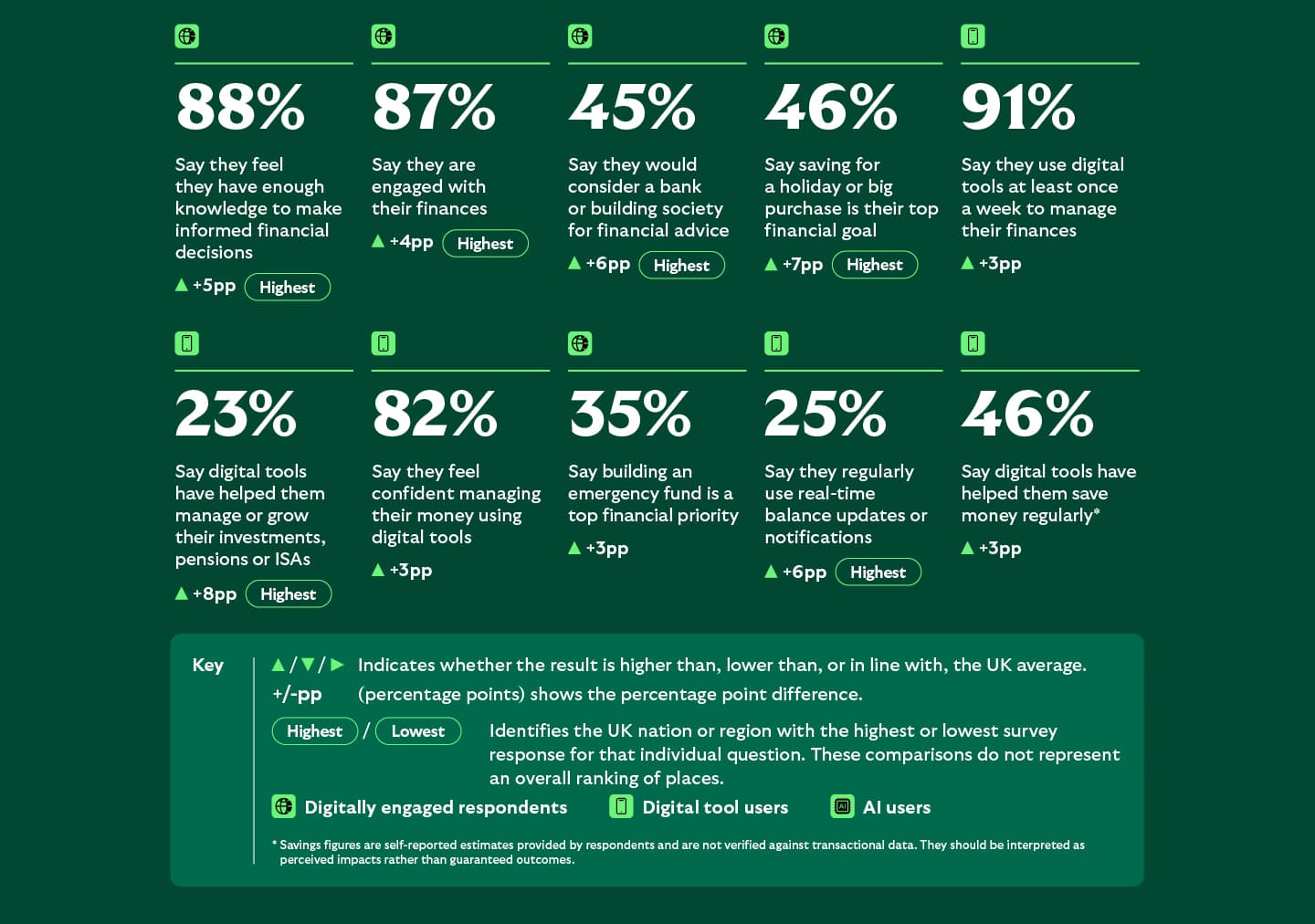
Wales combines particularly high financial engagement and knowledge with frequent digital money management. Among digital tool users, 91% manage or keep track of their finances digitally at least once a week, while reported benefits include regular saving and support with investments, pensions and ISAs.
Wales is particularly distinctive for longer-term digital money management: 23% of digital tool users say digital tools have helped them manage or grow investments, pensions or ISAs, compared with 16% nationally.
These findings point to a financially engaged and forward-looking profile. Wales shows characteristics of a Progress pathway, with an opportunity to build on established habits so that saving, planning and everyday money management support preparedness and longer-term security.

The South East combines high financial engagement with established digital money management and a focus on future security, including retirement saving and emergency planning.
Regular AI use is less prominent than elsewhere in the UK, suggesting a measured approach to newer technologies rather than a lack of engagement with digital finance generally.
The South East shows characteristics of a Stability pathway. The opportunity is to demonstrate where newer tools add practical value alongside established sources of support.

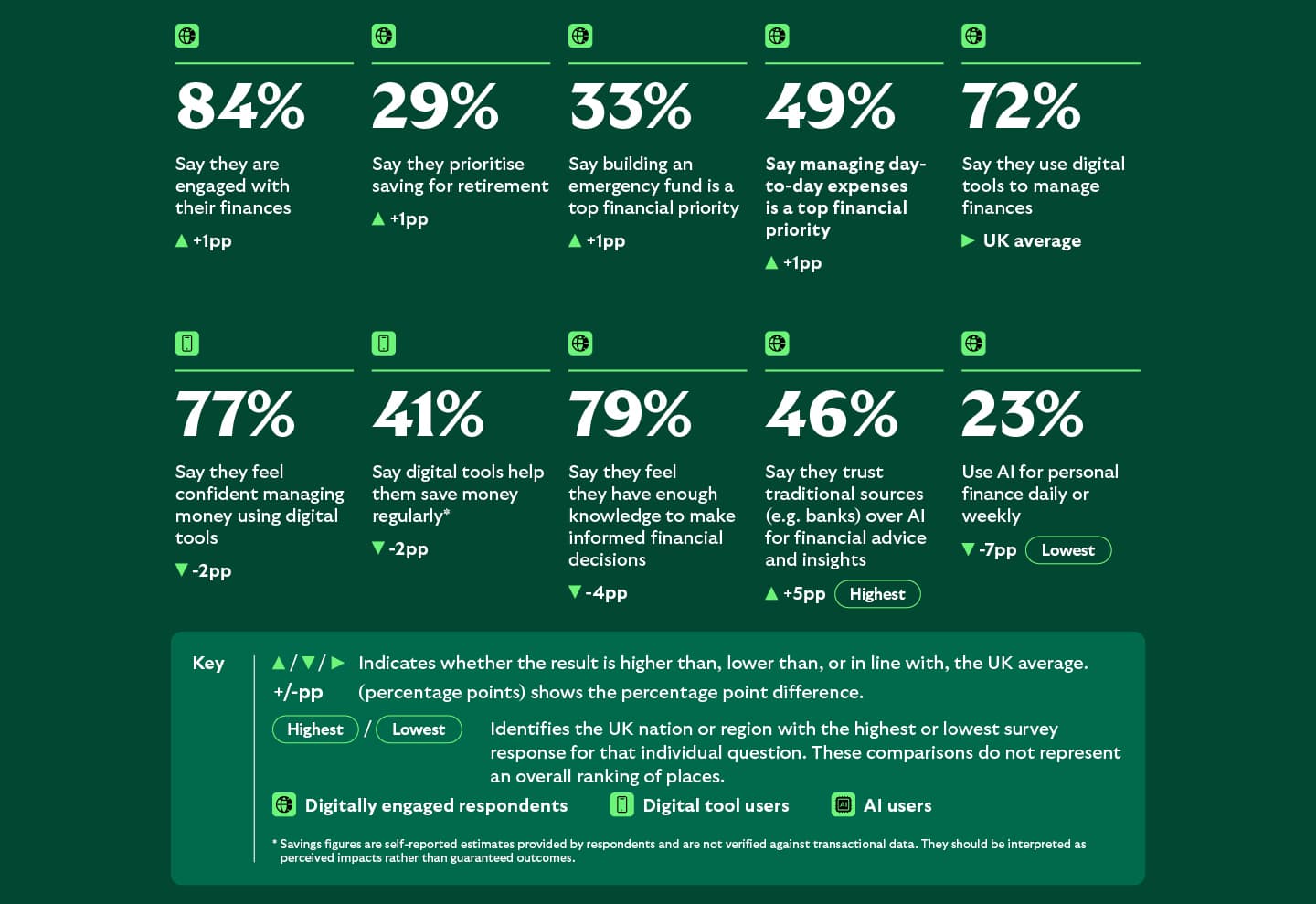
The South West stands out for the sense of everyday control associated with digital money management. Nearly half of digital tool users say these tools help them feel more in control, while regular saving is also a commonly reported benefit.
Financial priorities focus on household stability, including paying off debt, building an emergency fund and supporting family or dependants. Among those who have used AI for personal finance, savings goals and planning are also prominent.
The South West shows characteristics of a Stability pathway. The opportunity is to build on everyday control so that it supports greater resilience and longer-term progress.

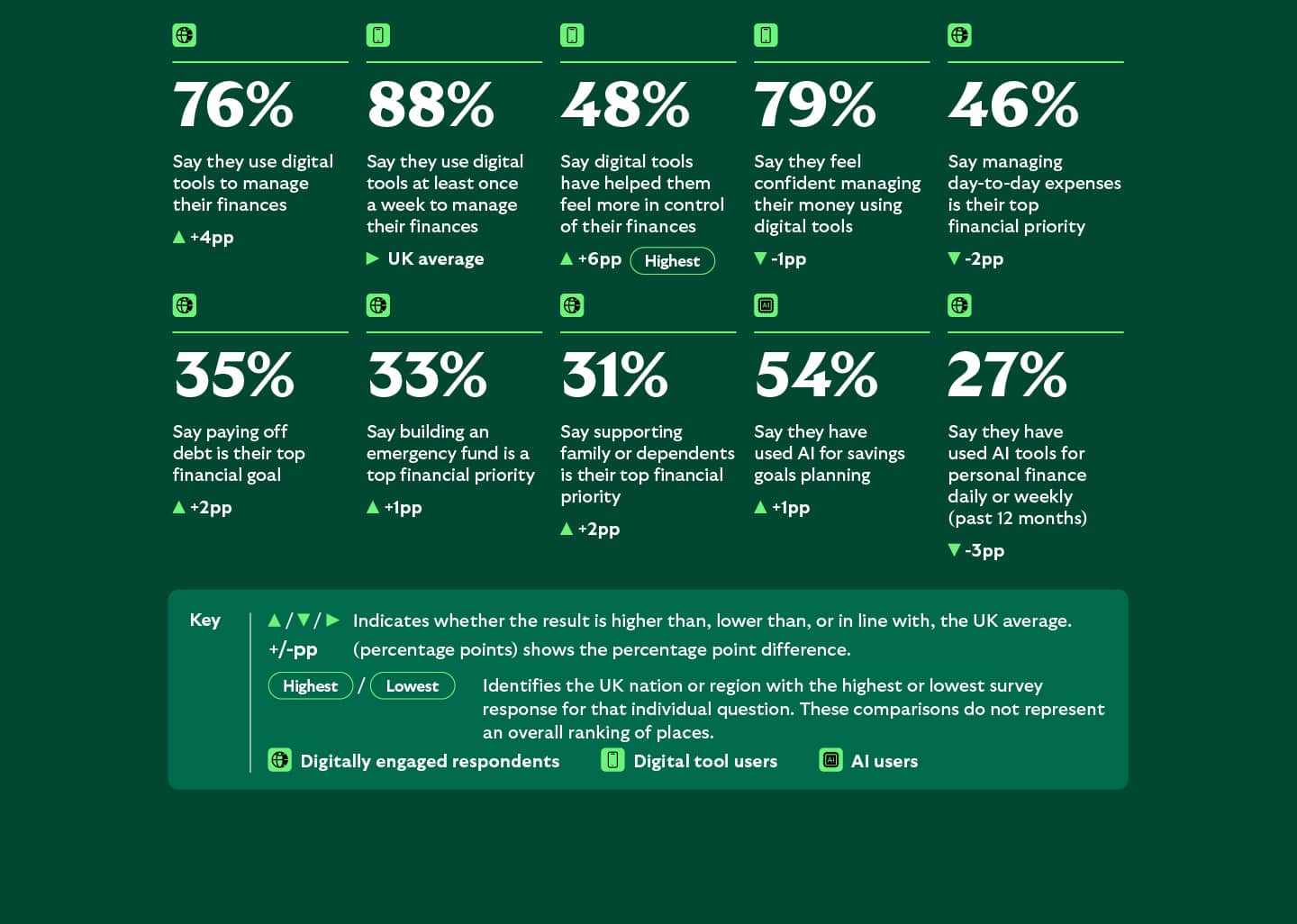
Respondents in the East of England report high financial engagement. However, digital tool users are less likely than elsewhere to say those tools help them feel more in control of their finances.
The East of England shows characteristics of a Stability pathway, with an opportunity to focus on the practical value and outcomes people experience, helping digital money management support greater confidence and control.

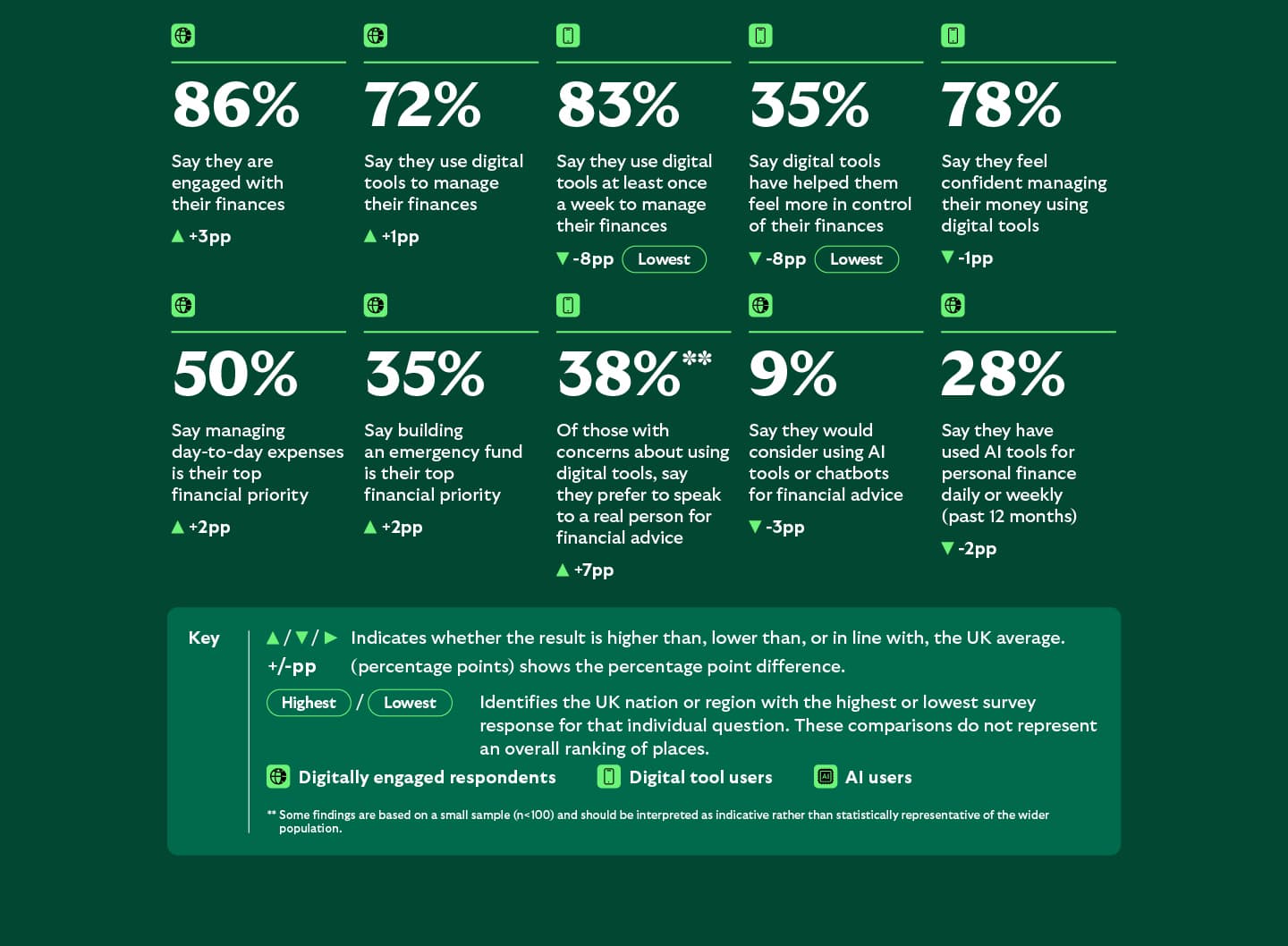
Yorkshire and the Humber stands out for the practical use of digital tools, particularly for budgeting and tracking spending. These behaviours sit alongside relatively strong digital confidence and a greater reported sense of financial control.
Among AI users, insurance comparison and advice is also particularly prominent, extending the practical comparison theme beyond everyday budgeting.
The region shows characteristics of a Stability pathway. The opportunity is to build on these practical habits so they support saving, confident decision-making and longer-term progress.

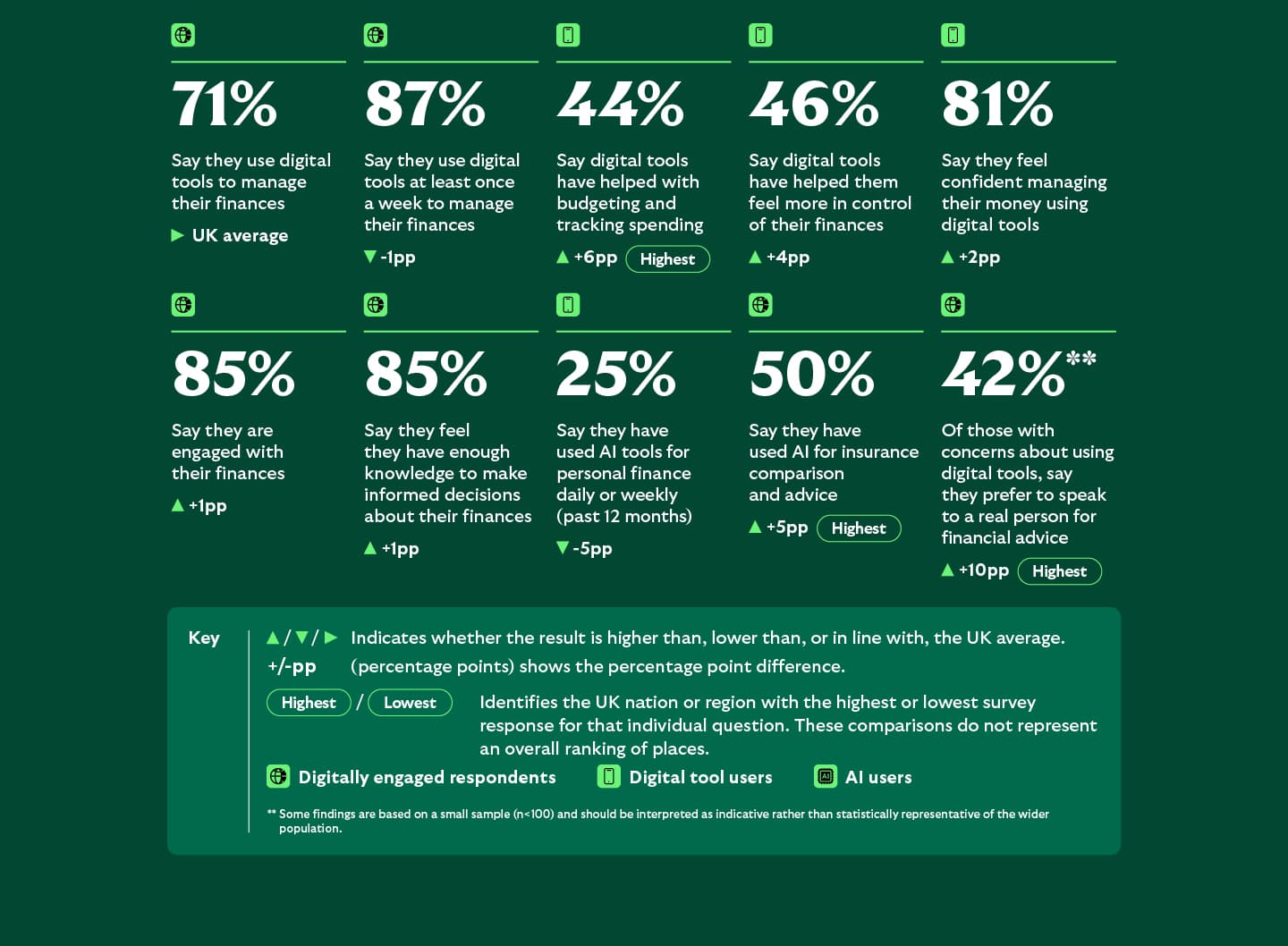
The East Midlands shows strong engagement with managing day-to-day costs and paying down debt. Among digital tool users, debt reduction is a particularly prominent reported benefit, indicating that digital money management is supporting immediate financial priorities.
The East Midlands shows characteristics of both the Stability and Resilience pathways, with an opportunity to help people build on progress, connecting effective debt management and everyday control with saving and longer-term financial security.

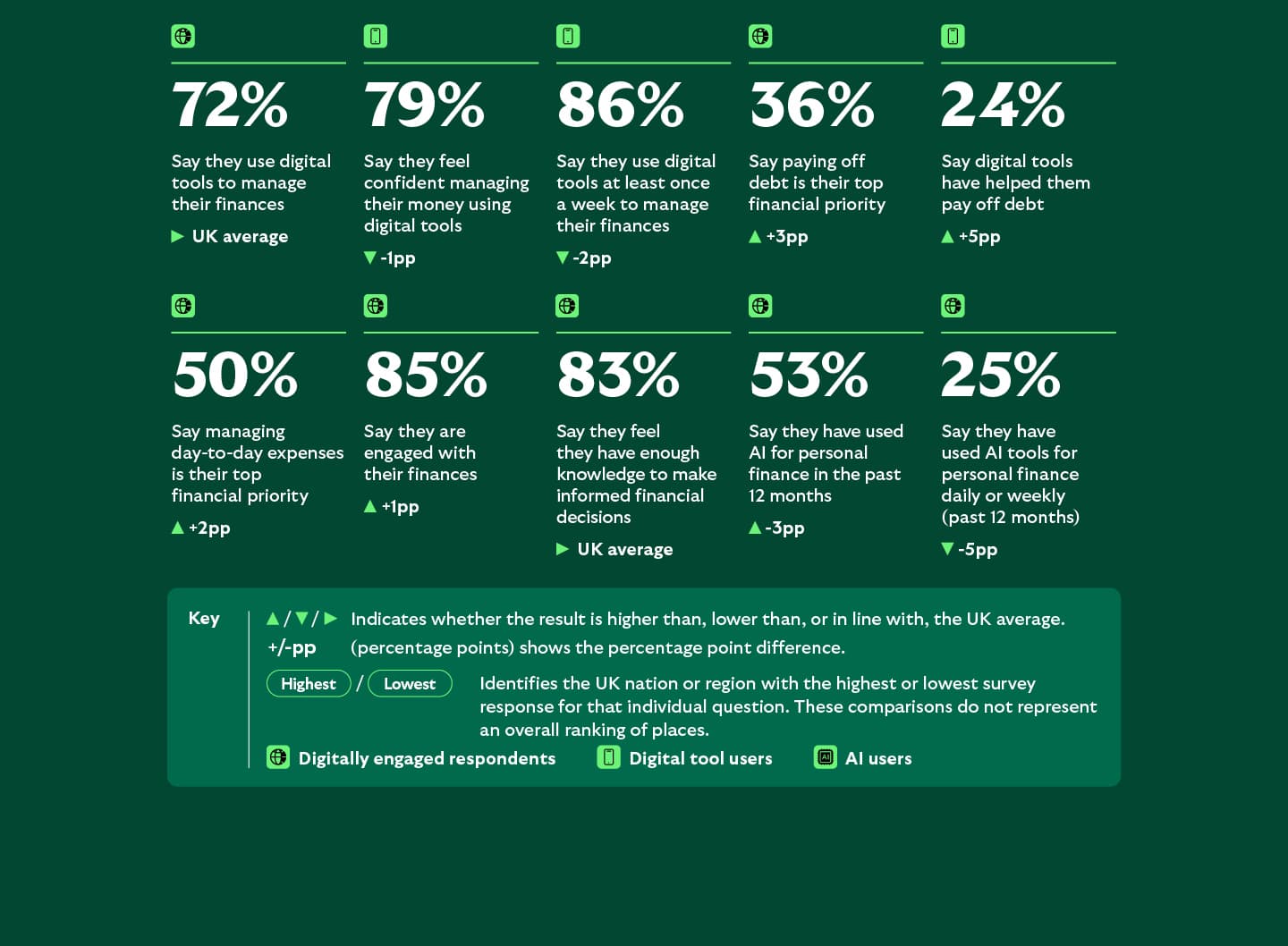
The West Midlands combines strong financial knowledge and digital confidence with above-average regular use of AI for personal finance. Among AI users, debt-management strategies are also a relatively prominent application.
At the same time, concern about bias affecting AI recommendations is particularly pronounced. This suggests that adoption does not remove the need for transparency, explainability and assurance about how recommendations are produced.
The West Midlands shows characteristics of a Stability pathway. The opportunity is to ensure that growing AI use is supported by clear, transparent and trustworthy information, helping people turn capability into confident financial action.

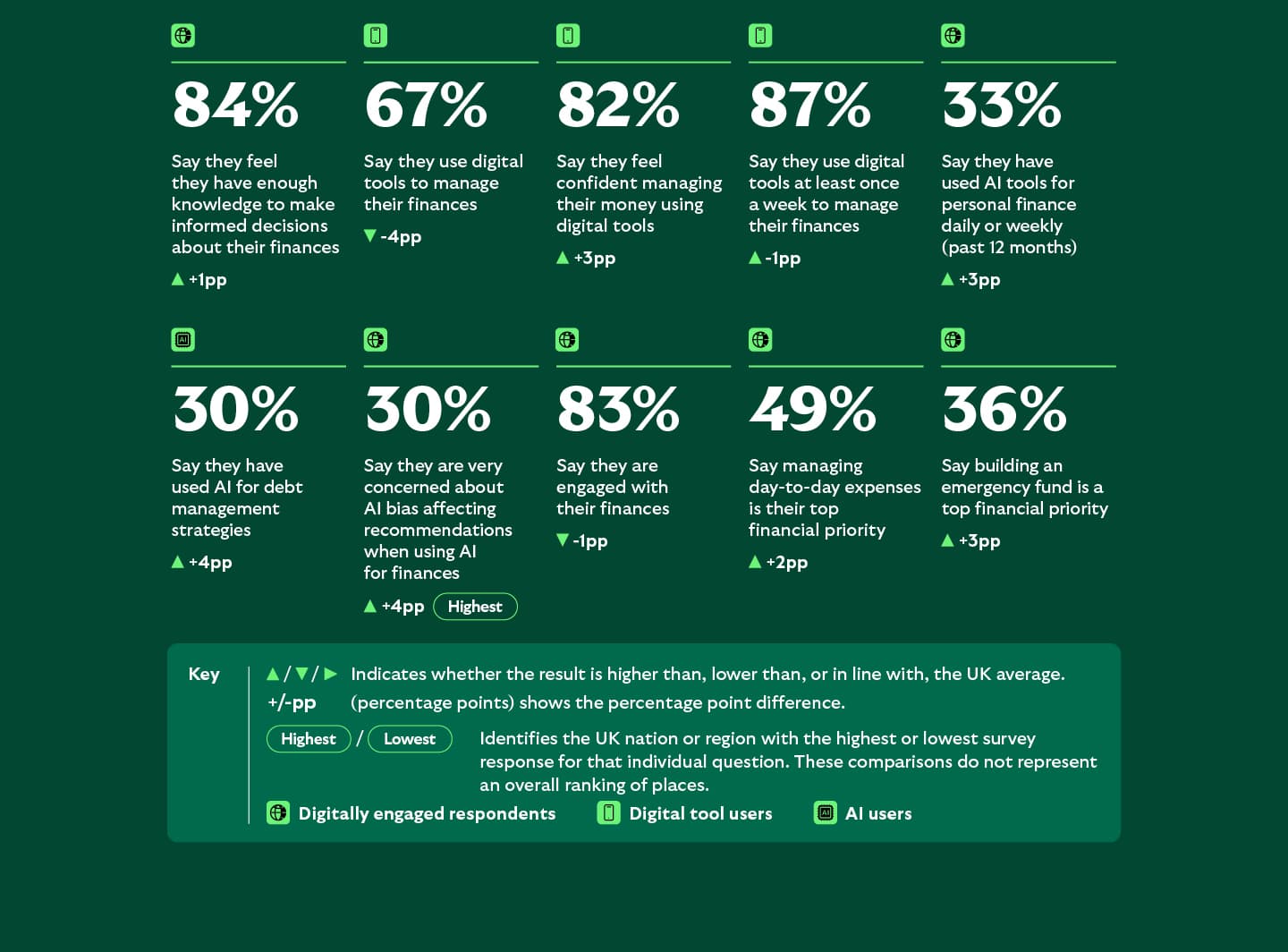
The North West combines relatively strong confidence in managing money digitally with established use of AI for both immediate and future-focused needs. Among AI users, debt-management strategies and future financial planning are relatively prominent.
The opportunity is to help people translate confidence, curiosity and existing digital activity into consistent financial behaviours and outcomes.
The North West shows characteristics of a Resilience pathway, with potential to turn capability into practical action.

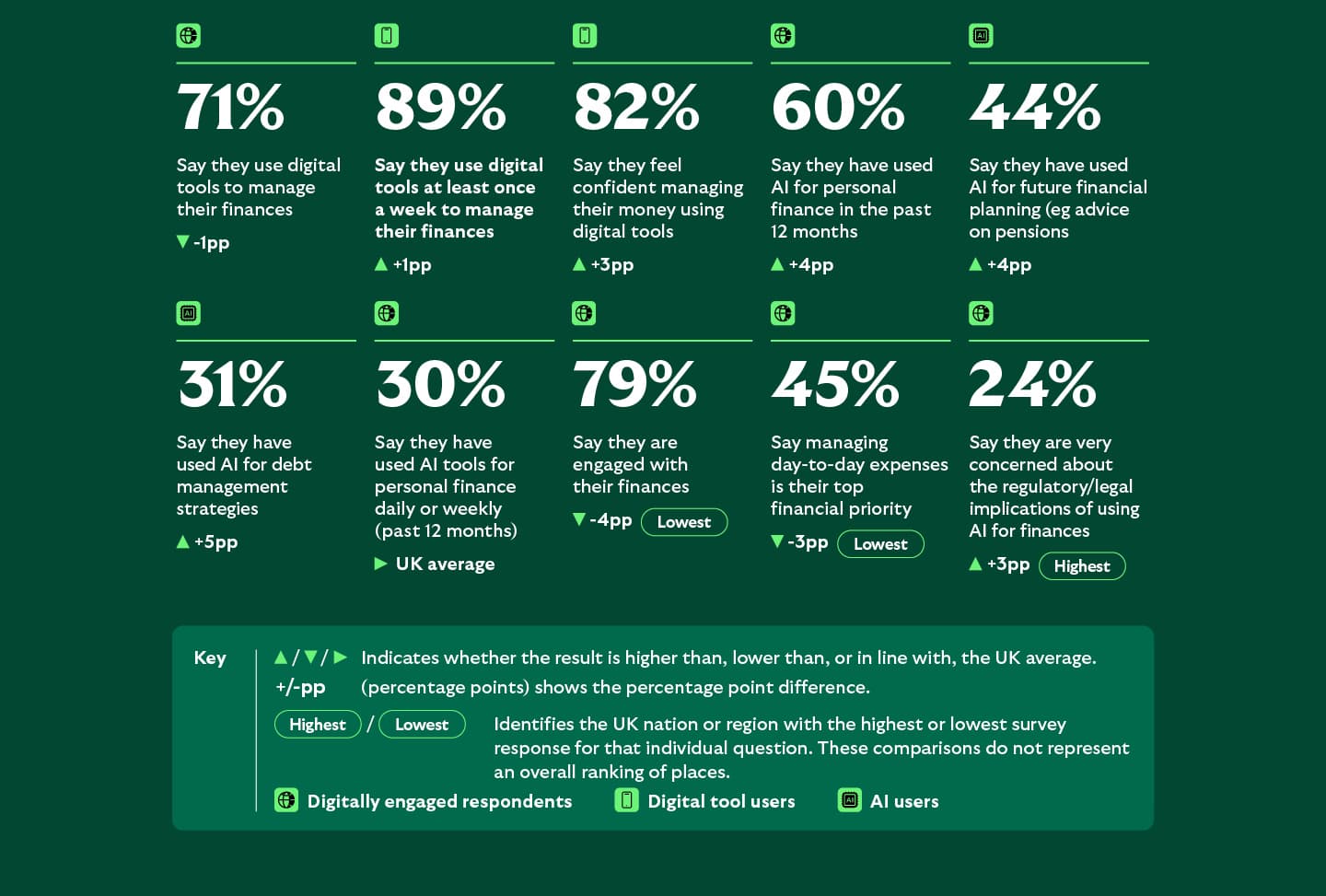
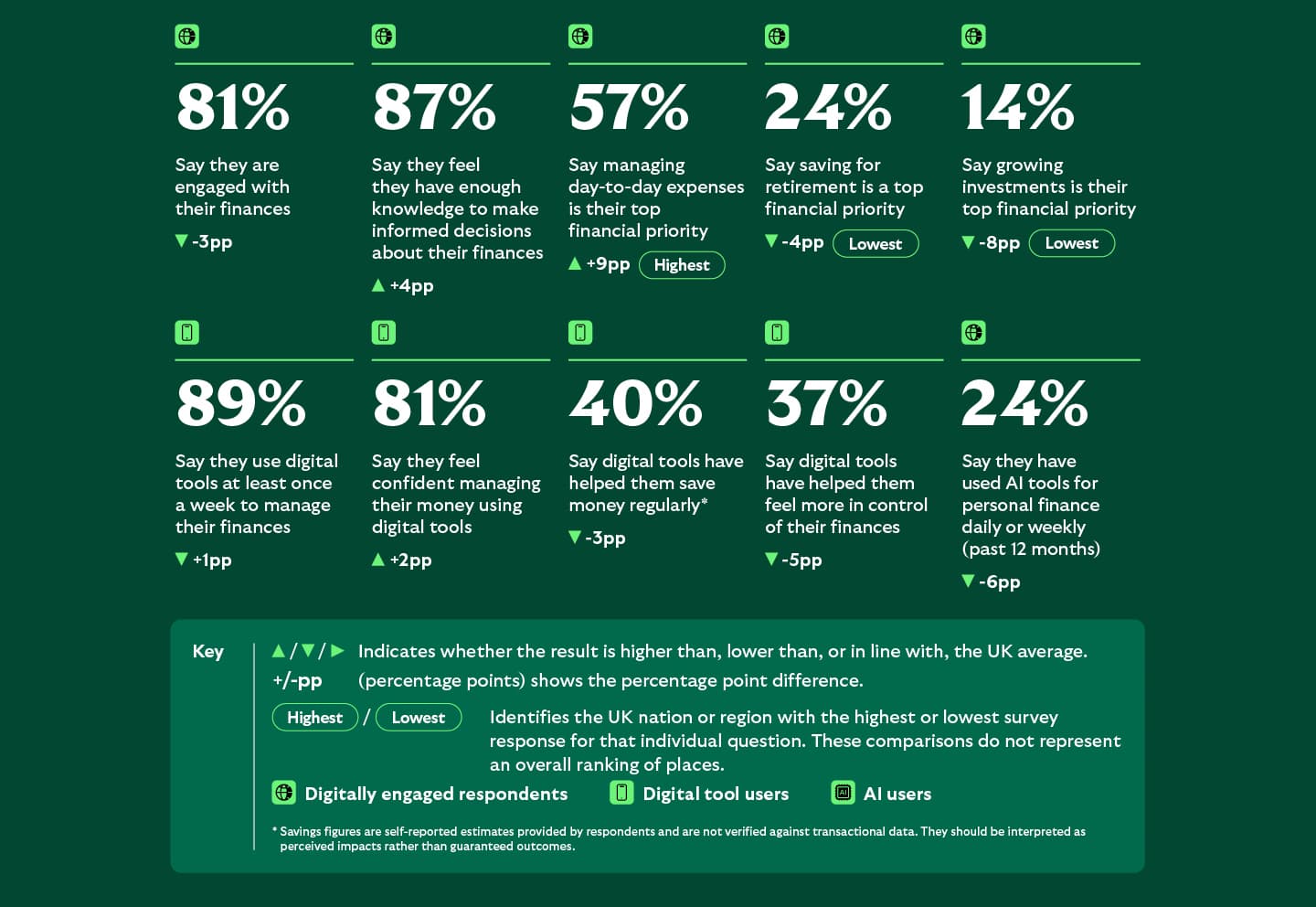
The North East combines strong reported financial knowledge with frequent digital money management among users. Managing day-to-day expenses is a particularly prominent priority, while retirement saving and investment feature less strongly.
Although digital tools are used routinely, reported saving and control benefits are also less prominent than the UK average.
The North East shows characteristics of a Resilience pathway, reflecting the importance of supporting immediate priorities alongside longer-term progress. The opportunity is to build on knowledge and routine money management so that they support stronger saving, financial control and planning ahead.

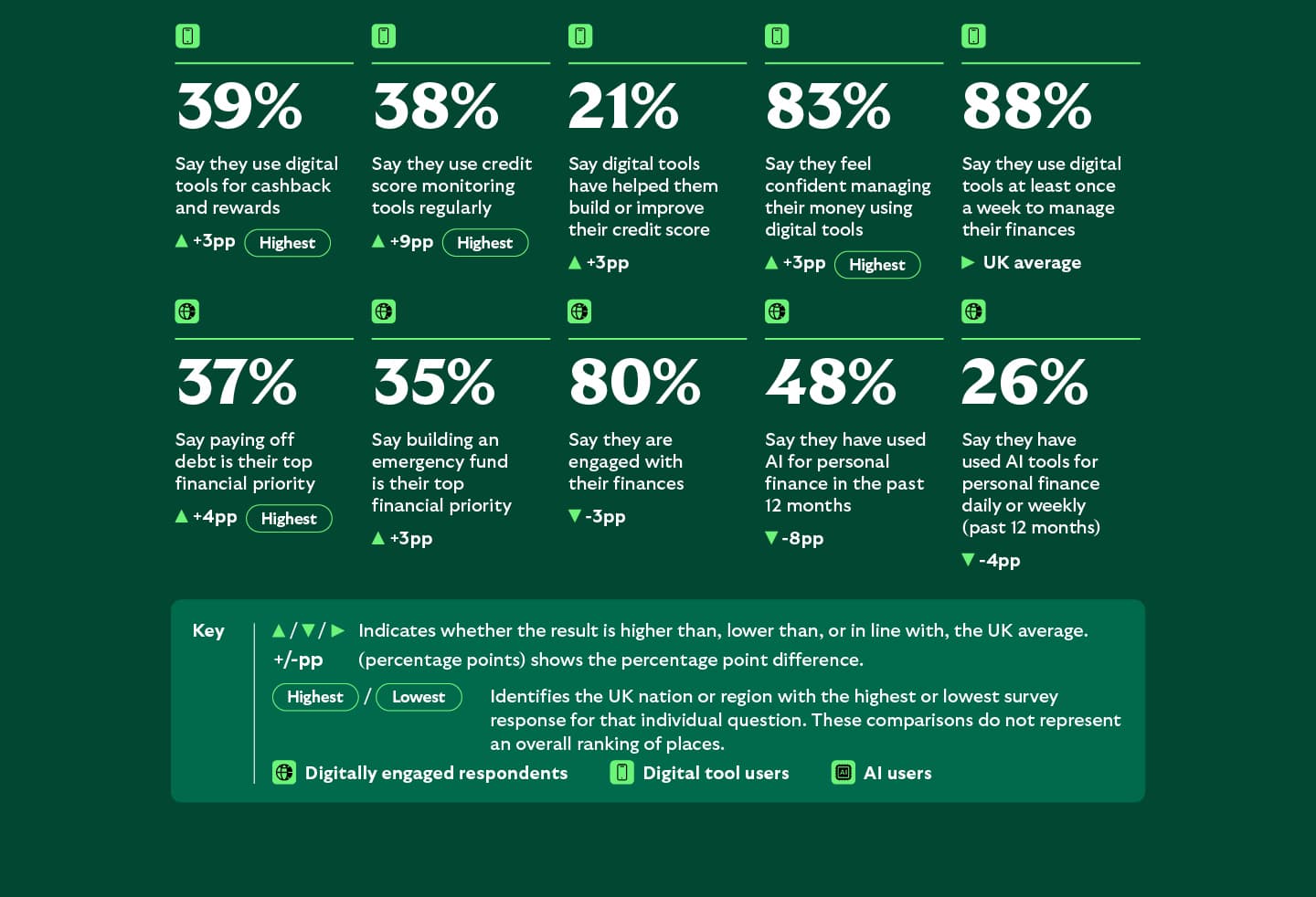
Scotland’s profile is characterised by confident, active use of practical tools among people managing money digitally. Regular use of cashback and rewards apps is higher than elsewhere in the UK, while credit score monitoring and reported credit score improvement are also particularly prominent.
Debt reduction and emergency saving point to a focus on financial security. Together, these behaviours suggest that digital tools are supporting practical, active money management across a range of everyday needs.
Scotland shows characteristics of both the Resilience and Stability pathways. The opportunity is to connect these active day-to-day behaviours with saving, investing and longer-term planning.

Northern Ireland combines lower reported financial knowledge with some of the strongest practical outcomes among active digital users. Money management is particularly frequent, while users report strong outcomes around efficiency and setting and achieving financial goals.
Financial priorities also point to ambition, including education, entrepreneurship and important life events. This creates an opportunity to strengthen knowledge and confidence around behaviours already associated with progress.
Northern Ireland shows characteristics of a Resilience pathway, alongside an opportunity to strengthen trusted support and help more people pursue their financial goals.

The findings in this report point to three broad, overlapping pathways that help explain how financial empowerment may be experienced across the UK's nations and regions.
These pathways are intended to provide context rather than categorise people or places. They are not sequential, and no pathway is inherently better than another. They are illustrative and should not be interpreted as fixed labels. Individuals and communities may experience aspects of several pathways at once, depending on their circumstances, confidence, financial priorities, support needs and local context.
Read alongside the regional findings, they help illustrate how different pressures, priorities and experiences can shape financial empowerment, and how digital tools may support people in different ways across the UK. The pathways are defined as follows:

Building towards longer-term financial security. People on this pathway appear more likely to use digital tools and AI to support saving, planning ahead, investment activity and longer-term decision-making. These patterns are most visible where financial priorities are focused on building future security and long-term financial goals.

Maintaining control and building stronger foundations. On this pathway, digital tools appear to help people stay organised, manage day-to-day finances and maintain a sense of financial control. The opportunity is to build on these behaviours so they can support saving, planning and stronger outcomes over time.

Managing immediate financial priorities while protecting stability. On this pathway, people’s financial behaviour may place greater emphasis on managing everyday expenses, reducing debt and staying on top of essential commitments. Digital tools can support control and practical money management, providing foundations from which longer-term progress may be built.
“Place matters. Having access to the right support, guidance and tools that reflect local needs and circumstances can help people feel confident, informed and prepared.”
The findings suggest that people's financial experiences and outcomes reflect a combination of local priorities, pressures, confidence and support needs. They do not point to a simple divide between more and less digitally advanced places. Instead, they show that digitally engaged people use tools for different purposes and report different outcomes. Digital tools, trusted guidance and human support may each play a role depending on the decision, circumstances and preferences involved.
Taken together, the findings suggest three broad opportunities: helping people build resilience under pressure, helping people maintain stability and control, and helping people make progress towards longer-term financial goals. These reflect the three financial empowerment pathways identified in the report.
Strengthening financial empowerment therefore requires coordinated action across government, industry and wider society, recognising that people may benefit from different forms of support depending on their circumstances and local context.
The opportunity is not simply to increase digital engagement. It is to help people use digital tools, trusted guidance and human support in ways that strengthen financial confidence, resilience and decision-making. By meeting people where they are and recognising that financial empowerment can take different forms across the UK, it is possible to support stronger financial outcomes for more people.
The following priorities highlight areas where targeted action could help strengthen financial empowerment:
“The future of financial empowerment is not about a single tool or solution. It is about helping people access the right combination of digital tools, trusted guidance and human support for their circumstances and goals.”
The Spotlight reports signal the future direction of the Consumer Digital Index: moving beyond digital engagement alone to better understand how digital tools, AI, guidance and human support can help people build financial confidence and improve outcomes in practice. Money mapped identifies three overlapping pathways: Progress, Stability and Resilience. These do not describe or rank places. They provide a framework for understanding how priorities, pressures, confidence and support needs may shape money management and reported outcomes.
For the Consumer Digital Index, this means continuing to explore not only whether people are digitally engaged, but whether that engagement helps them manage day-to-day finances, build resilience, access appropriate credit, plan ahead and act with confidence.
The opportunity is to use these insights to help ensure digital innovation supports real financial progress in ways that are trusted, inclusive and relevant to people’s circumstances.
Read together, Generation gains and Money mapped show that financial empowerment is shaped by intersecting factors, including life stage, personal circumstances, confidence, trust and local context.

Insights in this Spotlight are drawn from the Consumer Digital Index, published in November 2025. Findings, including AI usage and reported savings, are based on self-reported data from an online survey of 5,000 UK adults, nationally representative by age, gender and region, conducted between 3 and 28 July 2025. Respondents were digitally engaged and able to participate online.
Findings describe patterns and associations in survey responses; correlations do not imply causation.
References to third-party AI tools or social media platforms are illustrative only. They do not constitute regulated financial advice and are not endorsed by Lloyds Banking Group. Customers seeking personalised recommendations should use regulated advice channels.
Narrative summaries are interpretive and based on patterns in self-reported data and have been shortened for clarity. Full survey questions, context and survey base sizes are available in the Consumer Digital Index data tables.
The Consumer Digital Index, published in November 2025, combines anonymised behavioural data and nationally representative survey data to track digital engagement and financial capability across the UK. Earlier editions included a composite index score reflecting access, capability and use. Full methodology, data tables and report archives are available on the CDI website: Consumer Digital Index - Lloyds Banking Group plc.
Digitally engaged respondents: the main survey base, comprising respondents who were online and able to complete the survey.
Digital tool users: respondents who say they use the internet or digital services to manage their finances, for activities ranging from checking balances and tracking spending to saving and planning.
AI users: respondents who have used AI for personal finance in the past 12 months.
Digital tools: an umbrella term in this report for online and mobile financial services used to manage money, including banking apps and websites, spending insights, alerts, notifications, savings services and credit score monitoring.
At least once a week: combines every day, a few times a week and once a week.
UK nations and regions are used as a contextual lens to explore patterns in financial priorities, pressures, confidence, behaviours and reported outcomes. Findings do not describe everyone living in a place and should not be interpreted as fixed characteristics or labels applied to individuals, communities, nations or regions.
References to “highest” and “lowest” identify the largest or smallest reported percentage for one survey response across the 12 nations and regions presented. They do not represent an overall assessment or ranking of a nation or region, or indicate its overall financial outcomes, digital capability, access to services or performance.
The analysis focuses on how financial empowerment may be shaped by a combination of personal circumstances, local context, confidence, support needs and patterns of digital engagement. It does not seek to rank nations or regions, or imply that any place is performing better or worse than another. Instead, it explores how financial empowerment can take different forms across the UK, reflecting different priorities, experiences and opportunities for support.
Savings figures are self-reported estimates and are not verified against transactional data. They should be interpreted as perceived impacts rather than guaranteed outcomes.
Findings based on a small sample (n<100) should be interpreted as indicative rather than statistically representative of the wider population.
The Progress, Stability and Resilience pathways were developed by analysing survey responses relating to financial engagement, confidence, money management, financial behaviours and goals, trust and self-reported outcomes.
They represent broad, overlapping patterns rather than fixed categories, stages or labels. They are not sequential and no pathway is inherently better than another. Individuals may display characteristics of more than one pathway and may move between them over time.
Cross-cutting factors such as trust, confidence, financial pressure and local context can influence how digital tools are used and whether that use appears to be associated with meaningful financial action and positive outcomes.
Where nations or regions are described as showing characteristics of a pathway, this should be understood as directional and illustrative rather than definitive. The pathways are intended to provide context for understanding patterns in the data and should not be interpreted as rankings or assessments of places.
Through simple digital tools, personalised insights and timely guidance, we're helping people make informed decisions every day and take small but meaningful steps toward stronger financial futures.
8 May 2026 | Jas Singh
When people are financially empowered, they are better able to make informed financial decisions. They can spot opportunities, avoid costly mistakes, and make choices that align with their priorities and circumstances.
This Spotlight report explores how financial empowerment – having the confidence, capability and control to make informed financial decisions – varies across different life stages and age groups in the UK.
We're committed to supporting the UK's regions and communities, supporting the regeneration of low-income areas, addressing disparities, and fostering investment and growth.
Financial empowerment means having the confidence, capability and control to make informed financial decisions. It is about being able to manage money effectively, build resilience, plan ahead, act with confidence and make decisions that support long-term financial wellbeing. Digital tools, including AI, alongside trusted guidance and human support, can all play a role in helping people achieve this. Read our article on financial empowerment to find out more.
Money mapped is Lloyds Banking Group’s second financial empowerment Spotlight report, exploring how financial empowerment is experienced across the UK’s nations and regions. Drawing on insights from the 2025 Consumer Digital Index, it examines how digitally engaged adults use digital tools and AI to manage their finances, and how confidence, trust, behaviours and reported outcomes can vary across different parts of the country. The report explores how local priorities, pressures and circumstances can shape financial empowerment and the role digital tools play in supporting it.
Financial empowerment is not a single national experience. People's priorities, pressures, confidence and support needs can differ across the UK's nations and regions. In some places, digital tools appear more closely associated with day-to-day money management and financial control. In others, they are used to support saving, planning ahead and longer-term financial goals. These differences do not reflect fixed characteristics of places, but provide context for understanding how financial empowerment may be experienced in different ways across the UK.
The main finding is that digital tools such as banking apps, online services and AI can support people with different aspects of managing their money, but the ways people use them and the outcomes they report are not the same everywhere. While digital tools are already part of everyday financial life for many people across the UK, local priorities, pressures and levels of confidence can shape how they are used and the benefits people report.
Together, the findings suggest that improving financial empowerment is not about a single tool or solution. Instead, people may benefit from different combinations of digital tools, trusted guidance and human support, delivered through the channels they use and trust most and in ways that reflect their circumstances and local context.
No. The report shows that digital engagement alone does not guarantee financial empowerment. Financial confidence and positive financial outcomes are shaped by a combination of factors, including trust, knowledge, experience, financial pressures and access to appropriate support. The findings suggest that digital tools can support financial empowerment, but how people use them, and the outcomes they report, may vary across different circumstances and places.
Digital confidence can make it easier for people to manage money, compare options, access support and take action. The Consumer Digital Index finds that people who feel confident online are more likely to say digital tools save them time or money and help them feel more confident managing their finances.
People across the UK are using AI for personal finance in a variety of ways, including budgeting, savings planning, investment research, debt management, insurance comparison and future financial planning. The report suggests that usage patterns can vary between nations and regions, reflecting differences in financial priorities, confidence, goals and support needs. While some people use AI to support day-to-day money management, others are applying it to more complex financial decisions. As with other digital tools, the role AI plays appears to be shaped by individual circumstances, trust and local context.
The report identifies five key themes: financial empowerment can take different forms across the UK's nations and regions; digital tools can support confidence, control and financial progress when they are trusted and easy to use; AI is becoming part of everyday financial life but is being used in different ways across the country; trust, privacy and security continue to shape how people engage with digital tools; and people benefit from access to the right combination of digital tools, trusted guidance and human support for their circumstances.
Money mapped finds that the biggest differences are not simply whether people use digital tools, but what those tools are helping people achieve. In some places, digital tools appear more closely associated with day-to-day money management and financial control. In others, they are linked to saving, planning ahead, investing or longer-term financial goals. Together, these findings suggest that different places may benefit from different combinations of digital tools, trusted guidance and human support.
Among respondents in the analysis, London reports both the highest AI adoption (76% having used AI for personal finance in the past year) and the highest regular AI use (49% using it daily or weekly). The report also shows that people across the UK are using AI for a wide range of activities, including budgeting, savings planning, debt management, insurance comparison, investment research and future financial planning. As with other digital tools, how AI is used appears to be influenced by people's priorities, confidence and financial circumstances.
No. The Spotlight is based on an online survey of digitally engaged adults and examines how people who are already online use financial tools and the outcomes they report. It does not assess digital connectivity, digital inclusion, access to banking channels or the availability of in-person services. Regional differences provide context about priorities and experiences, not a ranking of digital inclusion or financial empowerment.
No. The report does not rank nations or regions. Instead, it uses place as a lens to explore how financial priorities, pressures, confidence and reported outcomes can vary across the UK. The findings highlight different experiences, strengths and opportunities rather than suggesting that any one nation or region is performing better or worse than another. A “highest” or “lowest” label relates only to one survey response and should not be interpreted as an overall assessment of a place.
The Consumer Digital Index finds that AI is now being used by millions of UK adults to help manage money. Common uses include budgeting, savings planning, financial education, investment research, debt management and future financial planning.
AI can support financial empowerment when it helps people understand their options, build confidence, make informed decisions and take practical action. The Consumer Digital Index positions AI as a potential tool for empowerment, but only when people can trust the information, understand its limits and access human support when needed.
The main risks are inaccurate, outdated or generic information, a lack of personalisation, privacy and security concerns, and over-reliance on tools that are not regulated financial advice. The Consumer Digital Index stresses that AI tools should be used carefully and that people should have access to trusted guidance and regulated advice where appropriate.
Trust is central to financial empowerment. The Consumer Digital Index shows that people may be willing to use AI and digital tools for money management, but concerns about accuracy, data privacy, security and personalisation affect how far they rely on them. Trusted providers, clear information and access to human support remain important.
Trust is central to financial empowerment. The Consumer Digital Index shows that people may be willing to use AI and digital tools for money management, but concerns about accuracy, data privacy, security and personalisation affect how far they rely on them. Trusted providers, clear information and access to human support remain important.
The Consumer Digital Index shows that being online and confident with digital tools can help people save time, save money, manage finances and build resilience. But digital inclusion is not only about access. People also need capability, confidence, trust and support to turn digital engagement into stronger financial outcomes.
The findings are based on an online survey of 5,000 UK adults, nationally representative by age, gender and region, conducted between 3 and 28 July 2025. The report focuses on people who are online and examines how digital tools and AI appear to support financial confidence, behaviours and outcomes. It is not a measure of digital access or inclusion. See [link] Context and methodology for more information.
Money mapped identifies three broad financial empowerment pathways: Progress, Stability and Resilience. These pathways help explain how financial empowerment may be experienced across the UK's nations and regions, reflecting different priorities, pressures, confidence levels and patterns of digital engagement.
They are intended to provide context rather than categorise people or places. The pathways are illustrative and overlapping, meaning individuals and communities may experience characteristics of several pathways at once. They are not rankings or fixed labels, but a framework for understanding different patterns of financial behaviour and reported outcomes across the UK.
Money mapped focuses on digitally engaged UK adults and explores how digital tools and AI may support financial empowerment. It does not assess digital access or digital inclusion, nor does it reflect the experiences of people who are not online.
Financial empowerment is not dependent on digital engagement. People can build confidence, resilience and control through a range of routes, including trusted guidance, community support, face-to-face services and other non-digital channels.
While digital tools can play an important role, the report highlights the value of providing people with access to the right combination of digital tools, guidance and human support. The wider Consumer Digital Index continues to explore digital access, capability and inclusion across the UK.